SCHOOL BADMINTON HALL LIGHTING RETROFIT
CPS Lighting designs and supplies sports lighting systems. At Longgang Experimental School, CPS renovated the lighting for an indoor hall with nine badminton courts used for PE lessons, student training and campus amateur matches. The project configuration lists 32 × 240 W CPH200 Series LED lights in a bilateral side layout.
The original account reports average illuminance above 750 lx across the nine courts and uniformity above 0.6. The installed LED ratings total 7.68 kW, calculated. The design objective combined useful court coverage, improved upward viewing conditions and a lower lighting load.
Share your court plan and mounting details. The simulation depends on those inputs; the installed result requires site verification.

9 courts
School PE, training and amateur matches
32 × 240 W
Documented CPH200 Series configuration
7.68 kW
Combined rated power, calculated
1. School badminton with a defined retrofit brief
The original installation comprised 116 metal halide lamps rated at 400 W each. The school’s brief described uneven brightness, glare, flicker and high electricity consumption. The replacement needed to support everyday teaching as well as training and matches, with less disruption from lighting maintenance.
| Project item | Original system | LED retrofit |
|---|---|---|
| Light sources | 116 × 400 W metal halide lamps | 32 × 240 W LED luminaires |
| Documented LED family | Not applicable | CPH200 Series |
| Listed rating total | 46.4 kW, calculated | 7.68 kW, calculated |
| Court coverage | Nine badminton courts | Nine badminton courts |
| Layout record | Exact old coordinates unavailable | Bilateral side arrangement |
On narrow screens, swipe the configuration table horizontally.
2. Position light around the upward playing view
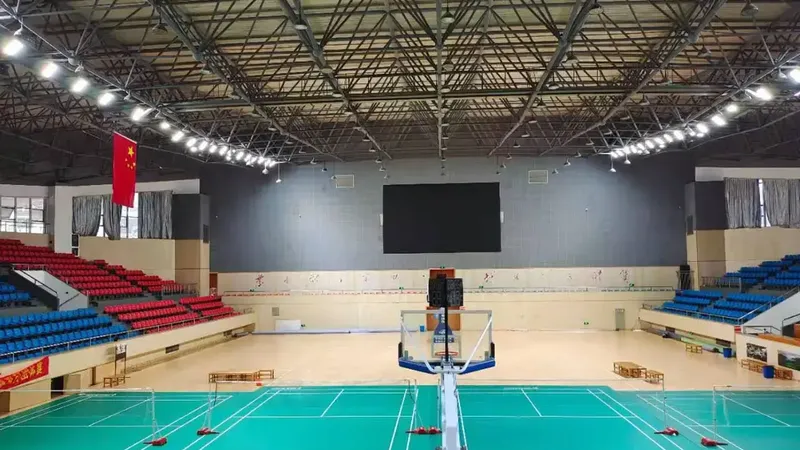
The supplied configuration specifies a bilateral side layout intended to address glare during badminton. Players repeatedly look upward to track the shuttle, so fixture position and aiming matter alongside light reaching the court. The photographs show the courts, spectator seating and lighting rows beneath a steel roof.
These images document one completed project, rather than a controlled before-and-after test. They do not provide exact mounting heights, coordinates or beam selections. For a similar school hall, model the court markings, roof structure, windows and likely player sightlines before setting fixture positions.


3. Reported lighting results and a transparent power comparison
The brief specifies average illuminance ≥750 lx and U2 uniformity ≥0.6. Its outcome paragraph reports all nine courts above those thresholds. The complete signed measurement report, grid, ratio definition and numerical glare or flicker readings are not supplied. These remain reported project results, rather than independently verified acceptance data.
The old article describes Class II training and Class III match objectives. Those descriptions do not establish complete compliance from two figures alone. A new project should agree the applicable lighting criteria and measurement method for its intended activities before commissioning.
| Comparison | Calculated value |
|---|---|
| Original lamp ratings | 116 × 400 W = 46.4 kW |
| LED luminaire ratings | 32 × 240 W = 7.68 kW |
| Difference in listed totals | 38.72 kW |
| Reduction in listed rated power | (46.4 − 7.68) ÷ 46.4 = 83.4% |
The 83.4% figure is a comparison of listed equipment ratings, not a metered electricity saving. Undocumented ballast losses are excluded from the old total. Circuit measurements, operating hours and control settings are needed to establish actual consumption, annual savings or payback.
4. CPS design, supply and project coordination
The case attributes the LED renovation to CPS and describes survey, optical design, delivery, installation and commissioning activities. For a new school project, confirm the division of installation responsibilities, electrical interfaces and access arrangements, then schedule the work around lessons and venue use.
CPS’s published OEM/ODM capabilities cover metal processing, finishing and assembly. Its testing laboratory lists electrical, optical and environmental equipment. These are company capabilities; proposed product tests, acceptance checks and warranty terms need confirmation for each supply.
5. Historical configuration and a separate current reference
Installed configuration: CPH200 Series, 32 units rated at 240 W. The source configuration identifies the series, but not a complete model suffix, driver or optical specification. These details require the historical order or datasheet.

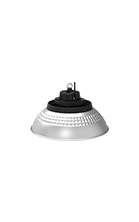
Dubhe Projection Light — 200 W
Current catalogue reference only; distinct from the installed CPH200 Series 240 W lights.
| Catalogue item | Published reference |
|---|---|
| Rated power | 200 W |
| Luminous flux | 30,000 lm |
| Colour temperature | 5700 K |
| Colour rendering | Ra ≥ 80 |
| Listed beam angle | 45° |
| Ingress protection | IP66 |
This reference illustrates a current CPS option for discussion. It is not presented as the historical product or a direct replacement. Suitability for badminton depends on photometric modelling, mounting geometry and the agreed glare assessment.
6. Plan your school badminton hall retrofit
Send a floor plan, court count and markings, clear height, mounting positions, photographs and intended playing level. Include teaching hours, installation access and any camera requirements. For an energy comparison, add the existing lamp and ballast schedule, controls and electricity records.
Share your court plan and mounting details. The simulation depends on those inputs; the installed result requires site verification.