Contents
1. Define the Site Constraints Before Pole Count
5. Engineering Decision Matrix
6. Standards, Sightlines, and Mounting Zones
1. Define the Site Constraints Before Pole Count

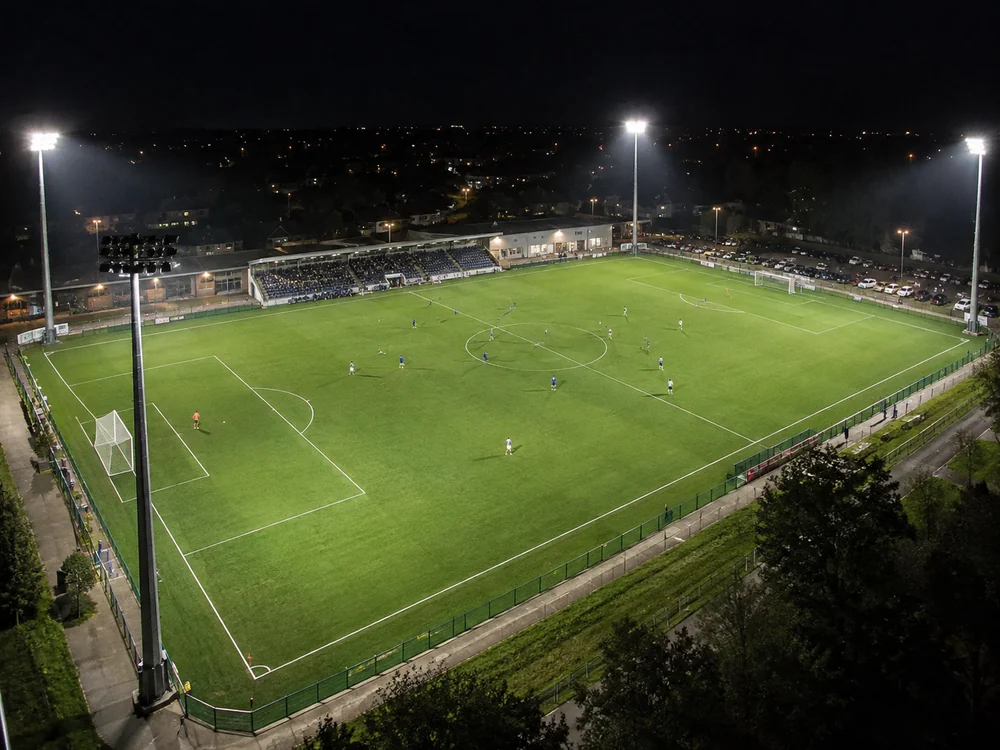
Consider a 105 m × 68 m football pitch with a grandstand on one touchline, a road near one corner, and a residential boundary behind a goal. A four-pole sketch may minimise foundations, but it may also force long beam throws across goalkeeper sightlines. Adding sideline poles can improve optical control, yet it increases civil works, cable routes, obstruction risk, and maintenance points.
This is why football lighting pole placement must begin with a coordinated site model. The model should include property setbacks, stand geometry, camera axes, player sightlines, underground services, crane access, local wind speed, foundation zones, and future expansion. Pole count is an output of these constraints, not the first design decision.
2. Corner Pole Placement
A four-corner layout concentrates luminaires on four high masts outside the pitch corners. It keeps both touchlines open and reduces the number of foundations, distribution boards, feeder routes, and lifting locations. The arrangement can be efficient for community grounds and non-broadcast competition fields when clear corner land and adequate mounting height are available.
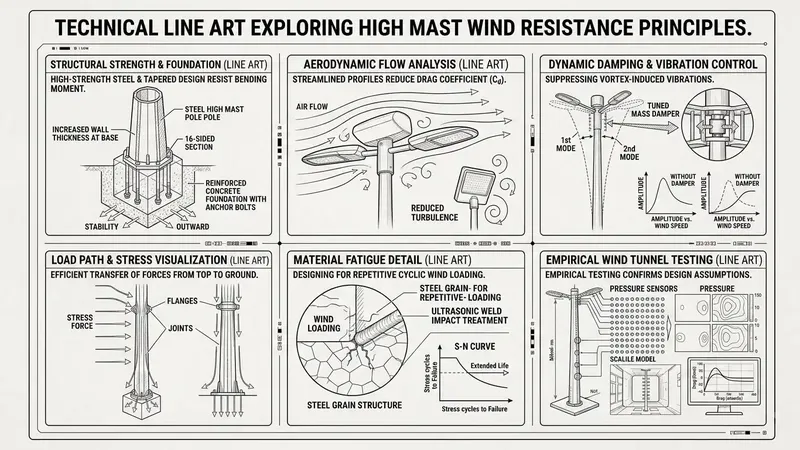
The trade-off is concentrated structural and optical demand. Each headframe carries more luminaire weight and effective projected area (EPA), while the far-side target points require longer throws and narrower intensity distributions. The basic structural relationships are EPA = A × Cd and overturning moment M = Σ(Fi × hi). Increasing mast height or headframe area therefore changes foundation demand as well as aiming geometry.
3. Sideline Pole Placement
A double-side layout normally distributes mounting positions along both long sides of the pitch. Shorter throws create more independent aiming paths, which helps engineers balance horizontal illuminance (Eh), camera-facing vertical illuminance (Ev), uniformity, and shadow direction. This control is valuable when several camera planes or broadcast viewpoints must be served.
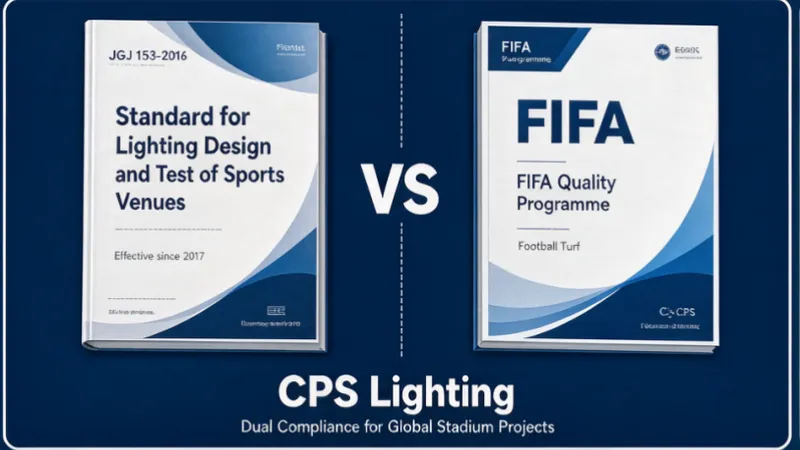
More poles do not automatically produce a better installation. Six or eight positions require additional foundations, trenching, feeder protection, controls, access clearance, and collision checks around spectator and team areas. The CPS comparison of FIFA and JGJ 153 lighting geometry identifies double-side mounting as a common broadcast-oriented arrangement, but the final coordinates still depend on the venue.
4. Hybrid Pole Placement
A hybrid system combines corner masts with sideline poles, roof-rim luminaires, or an additional linear row. It is often the practical retrofit choice when existing corner structures remain serviceable but cannot provide sufficient vertical light, perimeter coverage, or camera modelling on their own.

The added flexibility creates more aiming groups, switching circuits, structural interfaces, and failure modes. Existing poles must be checked for remaining load capacity before extra luminaires are installed. The CPS study of high-mast wind and structural calculations explains why luminaire EPA, gust pressure, mast height, and foundation moment must be assessed as one system.
5. Engineering Decision Matrix
The ranges below are concept-stage references, not universal requirements. Competition level, setbacks, optics, structural code, stand height, and local obtrusive-light limits can move a project outside these ranges.
| Layout | Concept arrangement | Primary advantage | Primary engineering constraint |
|---|---|---|---|
| Corner | 4 positions; high-pole case uses 4 × 18 m | Fewer foundations and clear touchlines | Long throws, concentrated EPA, goal sightlines |
| Sideline | Commonly 6 or 8 positions | More aiming paths for Ev and uniformity | More civil works, access conflicts, and cabling |
| Hybrid | Corners plus perimeter or roof positions | Targeted correction of weak zones | Complex controls, interfaces, and commissioning |
6. Standards, Sightlines, and Mounting Zones
The UEFA Stadium Lighting Guide 2023 places pitch-perimeter luminaires between 25° and 45° above the pitch centre and recommends at least 20–25 m above the surface where practical. It also warns against multiple tower luminaires within 15° on either side of the goal line. These limits protect goalkeeper and attacking-player sightlines while preserving useful vertical illumination.
UEFA further states that corner columns should not normally serve Level A stadiums unless additional luminaires are installed around the pitch perimeter. Pole geometry must still be verified against Eh, Ev, U1, U2, Glare Rating (GR), camera directions, and spill-light limits. A geometric rule defines the design envelope; it does not prove compliance by itself.
7. Simulation, Case Evidence, and Commissioning
A CPS Grade III high-pole football project used four 18 m lifting poles and achieved reported average illuminance above 550 lx after commissioning. This is project-specific evidence that a corner arrangement can work at that competition level when the optics, height, aiming, glare control, and switching modes are coordinated.

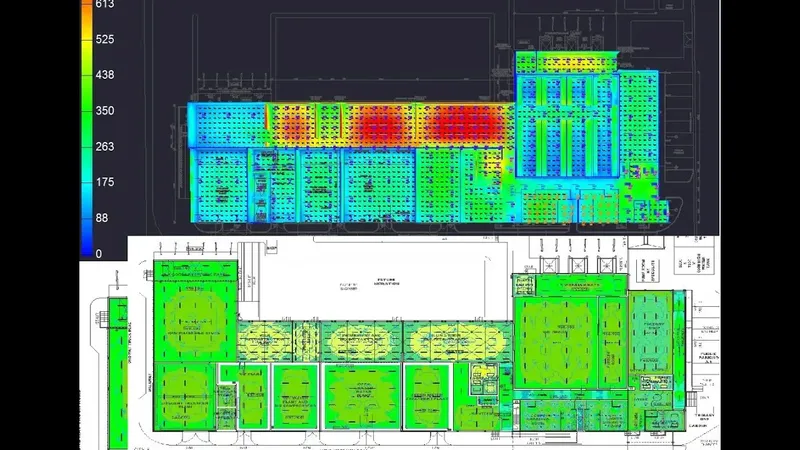
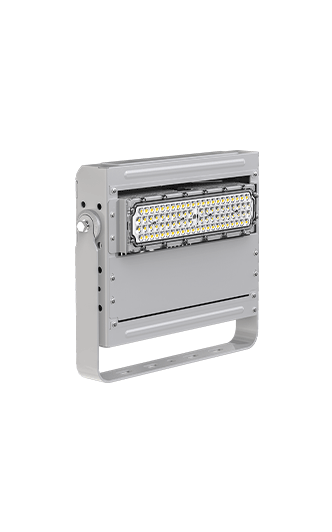
The same arrangement cannot be copied to another pitch without recalculation. Engineers should build separate options with verified IES or LDT files in DIALux or AGi32, then compare optical results, pole loading, trench length, access, and lifecycle maintenance. Products such as the Dubhe Projection Light 1000W and Polaris LED Flood Light TS-BJX provide different power and beam options, but the approved model and field measurements must validate the final selection.
Commissioning should record pole coordinates, mounting height, fixture pan and tilt, meter calibration, Eh and Ev grids, uniformity, GR, spill light, and every operating mode. The preferred layout is not simply the one with the fewest poles. It is the arrangement that meets the photometric brief, structural code, civil constraints, and maintenance plan with a documented margin.
8. Technical Sources
1. UEFA Stadium Lighting Guide 2023: design guide diagrams
2. UEFA pitch-perimeter luminaire mounting zone
3. CIE 112-1994 glare evaluation for outdoor sport
Core Keywords:
football lighting pole placement, corner pole layout, sideline pole layout, hybrid stadium lighting, high-mast lighting, LED sports lighting, pole height, effective projected area, wind load, photometric simulation, football field lighting