Contents
1. Read the Standard by Event Level
2. ITF Class III, II, and I Benchmarks
3. ATP and WTA Tournament Requirements
4. Uniformity, Glare, and Ball Visibility
5. Court Layout and Mounting Geometry
1. Read the Standard by Event Level
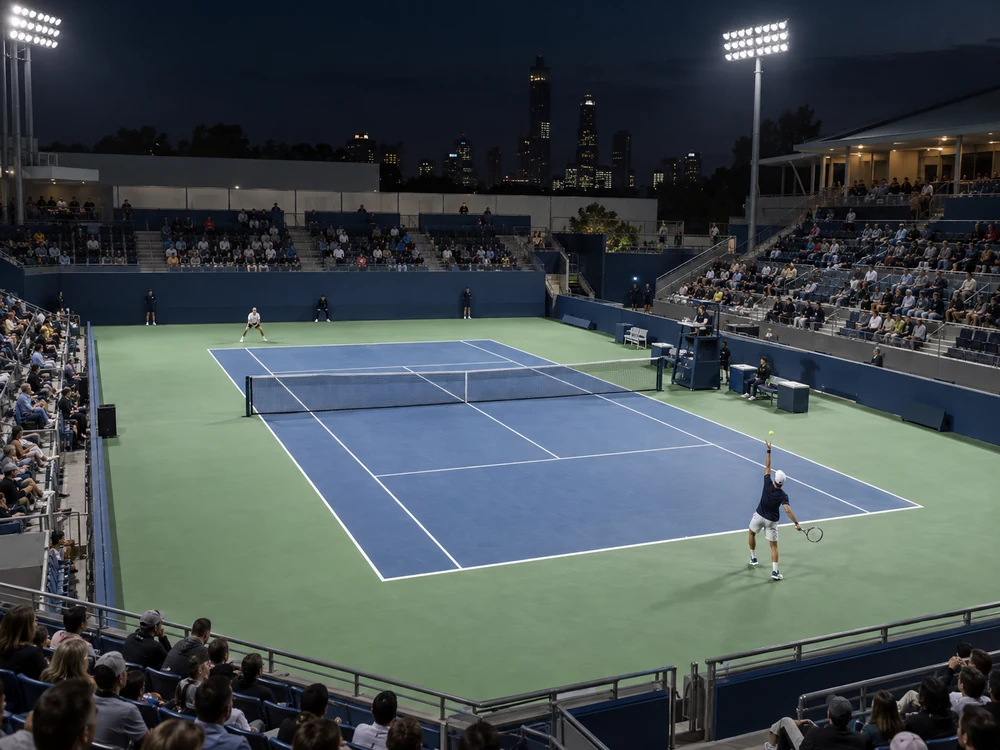
Consider a club that runs evening coaching at 300 lx and now wants to host a professional tournament. The existing court may feel bright to members, but the upgrade brief changes the measurement grid, uniformity target, glare limit, pole geometry, and camera requirements. A higher wattage alone cannot close that gap.
This is why ITF lighting standards must be read by competition level. The ITF Facilities Guide defines Class III, II, and I guidance for non-televised play. ATP and WTA rulebooks then add tour-specific requirements. A designer must identify the governing event before selecting luminaires or promising a lux value.
2. ITF Class III, II, and I Benchmarks
The ITF guide links Class III to recreation, schools, training, and small club events. Class II covers regional competition and high-level training. Class I covers top national or international competition without television. Its values are maintained values, so the installation should not fall below them during normal service.
| Reference level | Maintained Eh average | Emin/Eavg | Glare limit |
|---|---|---|---|
| Outdoor Class III | ≥ 200 lx | ≥ 0.60 | GR ≤ 55 |
| Outdoor Class II | ≥ 300 lx | ≥ 0.70 | GR ≤ 50 |
| Outdoor Class I | ≥ 500 lx | ≥ 0.70 | GR ≤ 50 |
| Indoor Class I | ≥ 750 lx | ≥ 0.70 | GR ≤ 50 |

Indoor values start higher: 300 lx for Class III, 500 lx for Class II, and 750 lx for Class I. The guide also recommends a 0.8 maintenance factor when better project data is unavailable. This means a design target must account for dirt and lumen depreciation instead of treating initial lux as maintained performance.
3. ATP and WTA Tournament Requirements
The 2026 ATP rulebook recommends at least 750 lx for ATP Challenger courts and 1,076 lx for ATP Tour courts, averaged over 15 on-court readings. The highest-to-lowest ratio must not exceed 2.0:1, while 1.5:1 is recommended. ATP also recommends about 2,000 lx for televised events broadcast in high definition.
The 2026 WTA rulebook requires 1,076 lx averaged over 15 readings for main-tour courts. It also lists 500 lx outside the court lines, a 1.5:1 high-to-low ratio, and 40 ft poles unless other non-show courts use greater heights. WTA 125 courts require 750 lx and recommend 1,076 lx. These are professional tennis lighting rules, not automatic targets for every club.
4. Uniformity, Glare, and Ball Visibility
A fast yellow ball crosses bright lines, dark fencing, players, and open sky. Average illuminance cannot describe those transitions. ITF uniformity uses Emin/Eavg, while ATP and WTA also state high-to-low ratios. The CPS guide to U1 and U2 uniformity explains how minimum, average, and maximum readings reveal different failure modes.
Glare becomes critical during serves, lobs, and overhead shots because players look toward the luminaires. Sharp-cutoff optics, side mounting, visors, and controlled aiming help protect the flight path. The CPS review of GR and UGR glare control gives the engineering background, but the applicable metric still depends on whether the court is outdoors or indoors.
5. Court Layout and Mounting Geometry
For one outdoor court, the ITF guide describes sharp-cutoff luminaires on columns about 8–12 m high. It shows two to four positions on each long side of the total playing area. Poles must stay outside collision zones, and adjacent courts may share higher columns when the photometric model proves the coverage.
Indoor luminaires should run parallel to the sidelines and remain outside the principal playing area. Fixtures should not sit directly above the marked court and full baseline runbacks. This geometry improves tennis ball visibility because players see a stable background instead of a bright source behind the ball.
6. Broadcast Light Beyond Lux
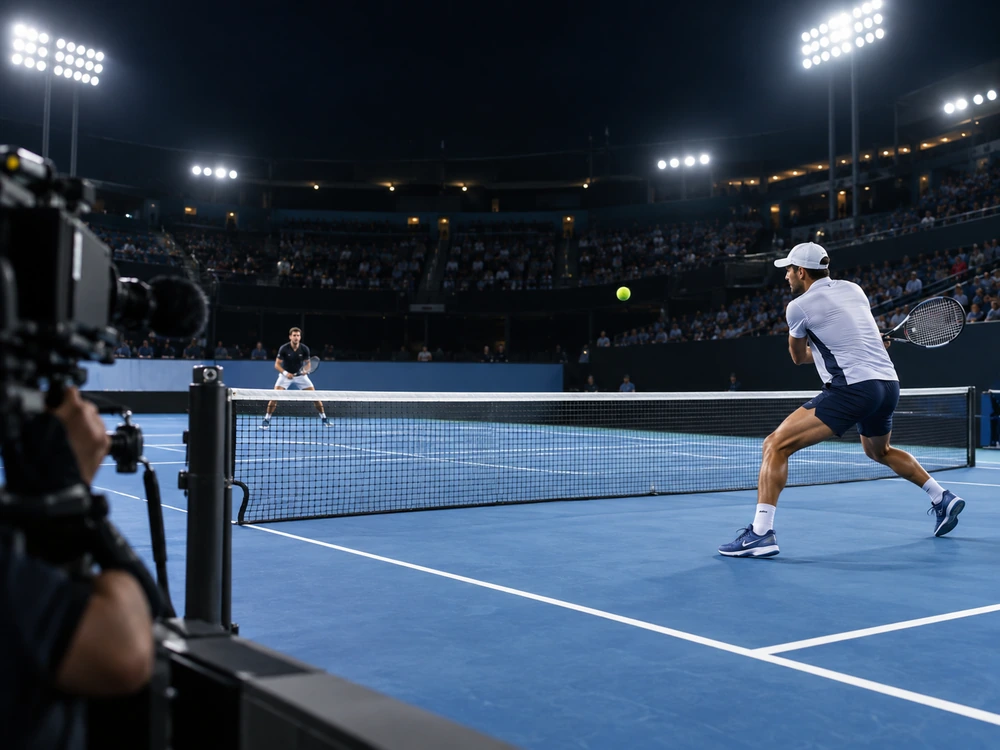
A broadcast court also needs usable vertical light on players and the ball. Engineers must coordinate camera-facing Ev, color consistency, CRI or TLCI, and driver behaviour with the broadcaster. The ATP 2,000 lx recommendation for HD does not replace these camera tests.
High-speed replay and electronic line-calling can expose modulation that spectators do not see. The project specification should therefore define an accepted flicker method, frame rate, dimming condition, and test procedure. The CPS article on flicker-free sports lighting explains why stable driver current matters when the ball is recorded at high speed.
7. Simulation, Measurement, and Case Evidence
The ITF guide uses a 15 × 7 calculation grid at 2.5 m spacing across the total playing area, with a reduced 5 m measurement grid permitted. Engineers should model verified IES or LDT files before installation. The CPS guide to DIALux and AGi32 simulation shows how the same model can also check glare, spill light, and aiming.

A CPS Asian Games tennis-centre project used a Class VI smart-pole system for high-level event and HD broadcast support. CPS reports that the system passed official acceptance. That result is project-specific, so it should support process credibility rather than replace an ITF, ATP, or WTA calculation.
After installation, technicians should record every reading, pole coordinate, luminaire pan and tilt, operating mode, and meter calibration. A product such as the Sirius Projection Light 600W may offer suitable court optics, but only the approved design and final measurements can confirm compliance.
8. Technical Sources
1. ITF Facilities Guide: lighting classes and measurement grid
2. ITF Facilities Guide: outdoor court lighting criteria
3. ITF Facilities Guide: indoor court lighting criteria
4. 2026 ATP Rulebook: Facilities and On-Site Conditions
5. 2026 WTA Rulebook: Tournament lighting standards
Core Keywords:
ITF lighting standards, tennis court lighting, ATP lighting requirements, WTA lighting standards, tennis court lux levels, lighting uniformity, glare control, professional tennis lighting, broadcast tennis lighting, tennis court floodlights