Contents
1. Start With the Site, Not the Rulebook
2. Leagues Regulate Play, Standards Regulate Light
3. What FIBA Actually Requires
4. Why the NBA Looks Stricter Than It Is
5. What the CBA Relies On in China
6. Compare the Numbers on the Same Axes
7. Glare, Uniformity and the Camera
1. Start With the Site, Not the Rulebook
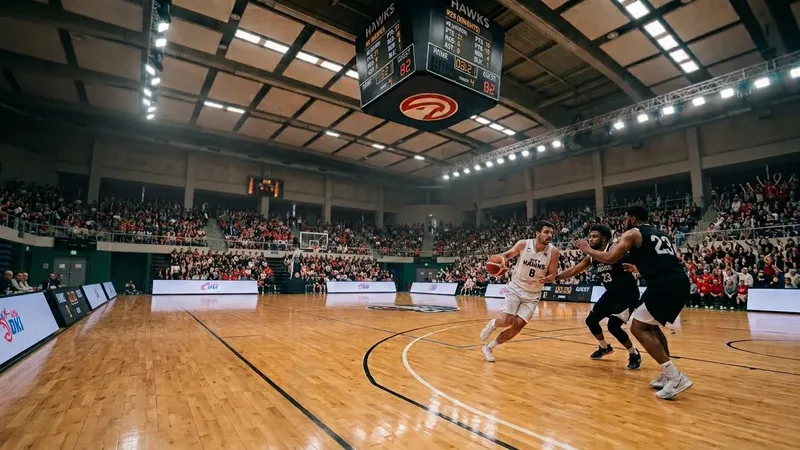
Picture a 28 m × 15 m court. The owners want "NBA-standard lighting" because a visiting club said the hall felt dim. Three advisers quote three numbers, and nobody can say which is binding. That gap between a league name and a photometric requirement stalls basketball court lighting projects.
The constraints are physical first. Mounting height caps the aiming angle. Players track the ball toward the rim, so a fixture near that sightline becomes a glare source. A polished floor doubles every bright aperture. Decide where fixtures sit and how little light lands on the wrong plane.

2. Leagues Regulate Play, Standards Regulate Light
Compare the three by separating two document families: the venue guidance a governing body publishes, and the photometric standard an engineer loads in a simulation tool such as EN 12193 or GB/T 50034-2024 with JGJ 153.
Leagues state what a venue must provide: a compliant floor, even light, and no direct glare into a player's eyes. They seldom fix lux values, uniformity ratios or flicker limits. Those live in the standards. One arena can be FIBA compliant and below NBA practice at once.
The league label tells you which competition the hall must host. The graded system in JGJ 153 gives the illuminance, uniformity and glare values that satisfy it.
3. What FIBA Actually Requires
FIBA rules reach every federation and the CBA as a member league. They require a court that is evenly and adequately illuminated, with no direct light into the eyes of players. The detail is in the FIBA equipment chapter on lighting: vertical illuminance at 1.5 m, Ra 80 or higher, and flicker factor below 1 percent.
FIBA runs 3x3 to a separate broadcast manual, and it is explicit: at least 1500 lx maintained vertical toward the camera. The 5-on-5 tier table sits in a facility guide that is sold rather than published.
4. Why the NBA Looks Stricter Than It Is
The NBA publishes no court lighting specification. Its rulebook covers the court and the basket, and the only lighting item is the LED strip behind the backboard glass. Arena lighting follows the broadcast chain: 4K cameras at high frame rates, and replays that punish flicker and weak vertical illuminance.
Practice runs far above the FIBA baseline. One documented NBA arena upgrade reports that vertical footcandles roughly doubled. No lux figure is published. That is not a mandate; it is what owners and broadcasters agree on.
Treating practice as code is a common tender error. A supplier promising "NBA level" in writing makes a marketing claim. A defensible brief names the standard and grade, then states the camera requirement in lux, uniformity and flicker terms.
5. What the CBA Relies On in China
The CBA sits under FIBA rules, and its venues are built to Chinese standards. Its league rule requires at least 1000 lx horizontal and vertical, measured 1 m above the floor. GB/T 50034-2024 replaced GB 50034-2013 in 2024.
GB/T 50034-2024 sets uniformity through ratios, and caps flicker index at 1 with SVM at 1.3. Its with-television values are vertical. JGJ 153-2016 adds the venue grades and a maintenance factor of 0.8.
Consider one verified example. CPS Lighting lit the basketball and judo venue of the 7th Military World Games in Wuhan, an 18,000 m² hall with 5,215 seats, using 200 W to 1200 W Sirius projection luminaires, designed to the Class VI criteria of JGJ 153. Those results belong to that venue, not to every hall that buys the same luminaires.
6. Compare the Numbers on the Same Axes
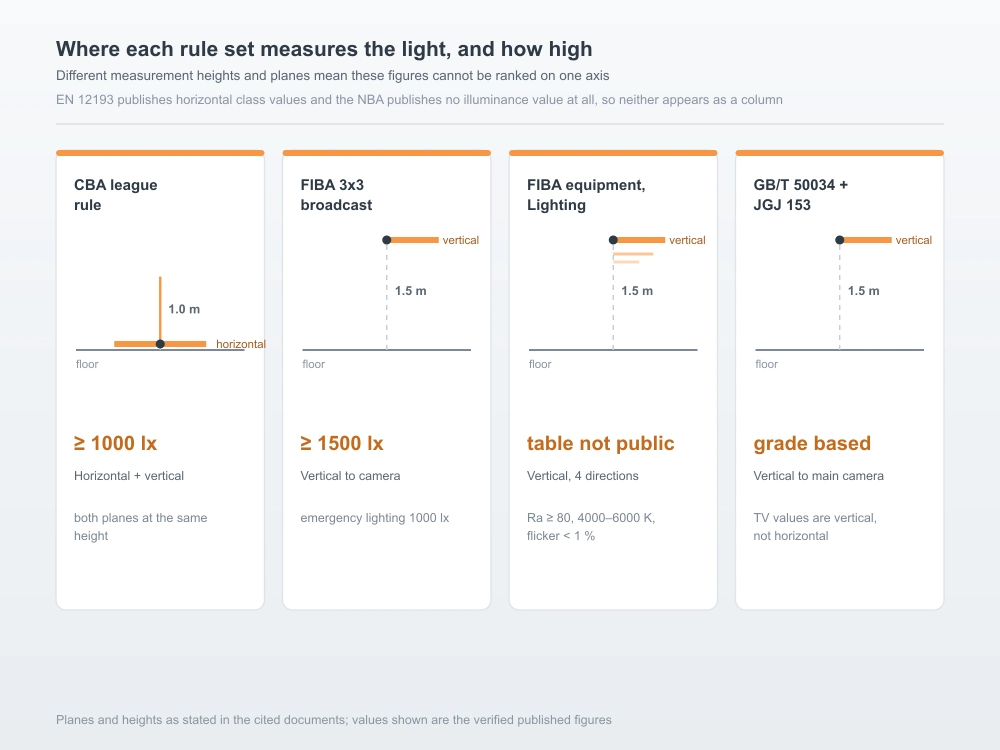
Compare every requirement on the same axes: what the document governs, the competition level, the maintained horizontal illuminance, and whether a camera changes the target. The table keeps published values and practice apart.
| Rule set or standard | What governs the lighting | Value or requirement | Source status |
|---|---|---|---|
| CBA league rule | Club admission for televised games | ≥ 1000 lx horizontal and ≥ 1000 lx vertical at 1 m above the floor | League regulation. Measured at 1 m, not the 1.5 m used by FIBA and JGJ. |
| FIBA 3x3 TV Production Manual | Broadcast of 3x3 events | ≥ 1500 lx maintained vertical toward the camera; ≥ 1000 lx emergency | First-party broadcast manual. |
| FIBA equipment chapter, Lighting | Court and camera light quality for FIBA competitions | Vertical illuminance at 1.5 m in four directions; Ra ≥ 80; 4000–6000 K; flicker factor < 1 % | Numeric illuminance table is a printed table, not retrievable. Qualitative glare rule: no glare whatsoever into players’ eyes. |
| NBA rulebook | Court, basket, backboard | No lighting requirement; only backboard LED strips | No NBA illuminance specification exists. Arena practice only: one documented upgrade reports roughly doubled vertical footcandles, with no lux value published. |
| GB/T 50034-2024 | National lighting design standard (in force since 2024-08-01, replacing GB 50034-2013) | Main-camera vertical uniformity ≥ 0.4 min/max and ≥ 0.6 min/average; flicker index ≤ 1; SVM ≤ 1.3 | Mandated standard. With-television values are vertical toward the main camera, not horizontal lux. |
| JGJ 153-2016 | Sports venue lighting grades, design and testing | Camera-direction vertical ≥ 1800 lx for HDTV with super-slow-motion; percent flicker ≤ 6 %; maintenance factor 0.8; CCT ≤ 6000 K | Industry standard, mandatory for testing before major competitions. Grade tables are printed tables, not retrievable. |
| EN 12193:2018 | European indoor and outdoor sports lighting | Class-based illuminance and uniformity for basketball | Standard confirmed at the 2018 edition. Class values are paywalled and are not reproduced here. |
Two conventions decide whether a comparison holds. Height and plane differ: the CBA rule measures at 1 m, FIBA and JGJ 153 put vertical illuminance at 1.5 m, and EN 12193 publishes horizontal values. Uniformity notation differs too, and JGJ 153 defines its own.
Design margin belongs in the comparison. A scheme that meets the target only at full output fails later, once dust, ageing and driver degradation take their share. The maintenance factor decides whether the hall still passes in year five.

7. Glare, Uniformity and the Camera
Basketball adds a demand outdoor field sports do not have: the light must serve a gaze that points upward. Players shoot with their eyes on the rim, so a luminaire mounted low or angled back becomes disability glare. Indoor halls use UGR, outdoor courts use GR. Move the light off the sightline and shield the aperture, or one fixture produces the double shadows that players read as two balls.
On a small court, one badly aimed fixture creates a hotspot that moves the U1 and U2 values across a floor of only 420 m². Catwalk mounting with overlapping asymmetric beams beats a grid above the court, because it removes the brightest reflection from the polished floor.
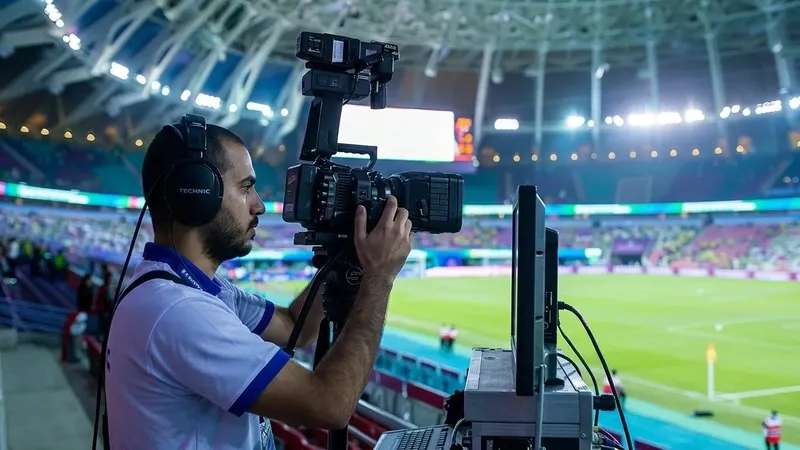
Once a camera is added, vertical illuminance and flicker move to the centre. Broadcasters see players from the side, so the plane facing the main camera renders faces and movement. Slow-motion replay exposes any driver that modulates output, which is why broadcast specifications set their own flicker ceiling.

8. Simulation, Measurement and Acceptance
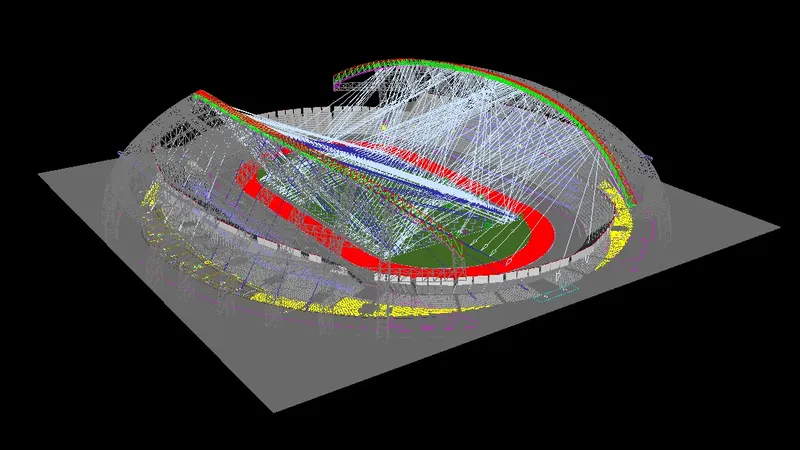
Whatever comparison the brief uses, the project ends with a measurement. Set the competition levels and camera positions, model the court in DIALux or AGi32 on a documented grid, then verify with a calibrated meter.
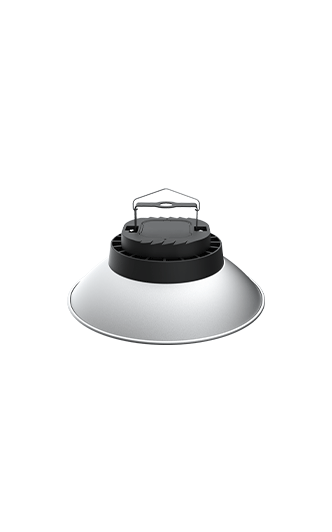
A defensible record lists the standard and grade, the measurement height and grid spacing, measured average and minimum illuminance, the uniformity ratios, the glare metric, colour rendering, and the flicker result for televised venues. A hall at CBA or broadcast level is usually lit with a modular LED stadium floodlight rather than a warehouse high bay. Reference layouts are collected in the CPS basketball lighting projects.
9. Technical Sources
FIBA Official Basketball Rules — Basketball Equipment, Chapter 17 (Lighting) — FIBA, 2018 edition, Chapter 17. Source of the lighting requirements quoted here: vertical illuminance at 1.5 m in four directions, Ra ≥ 80, colour temperature 4000–6000 K, flicker factor < 1 %. The illuminance table itself is published as a printed table and is not publicly retrievable.
FIBA 3x3 TV Production Manual 2021, Power, Lighting and Utilities — FIBA 3x3, 2021, section 1.1. Maintained vertical illuminance of at least 1500 lx toward the camera, plus emergency lighting of at least 1000 lx.
FIBA news: Official Basketball Rules 2024 in force from 1 October — FIBA, 2024. Confirms which edition of the rules and equipment documents is current.
2013–2014 CBA competition regulations (中国男子篱球职业联赛竞赛工作规定) — Chinese Basketball Association league document, 2013–14, venue section: horizontal and vertical illuminance of at least 1000 lx measured 1 m above the floor. Measurement height differs from the 1.5 m used by FIBA and JGJ 153.
Ministry of Housing and Urban–Rural Development announcement No. 33 of 2024: GB/T 50034-2024 — First-party notice that the architectural lighting design standard GB/T 50034-2024 took effect on 1 August 2024 and replaced GB 50034-2013.
GB/T 50034-2024 full-text reproduction, clauses 4.2–4.5 and 5.3 — Reproduced clause text for uniformity ratios, flicker index and SVM limits, and the note that with-television sports values are vertical illuminance toward the main camera. The numeric tables are published as images.
JGJ 153-2016, Design and Testing Standard for Sports Venue Lighting — Reproduced clause text for the venue grades, the 0.8 maintenance factor, the camera-direction vertical illuminance for HDTV with super-slow-motion, and the percent-flicker limit. Grade tables are published as printed tables.
NEN-EN 12193:2018, Light and lighting — Sports lighting — Standards body record confirming the current edition, published 1 December 2018, superseding the 2008 edition. Class values are paywalled and are not reproduced in this article.
CIE 083:2019, Guide for the Lighting of Sports Events for Colour Television and Film Systems, 3rd edition — CIE, 2019. Advisory guidance for broadcast lighting; not a mandatory code.
ANSI/IES RP-6-20, Sports and Recreational Area Lighting — Illuminating Engineering Society, 2020 edition. Referenced as the North American recommended practice; its content could not be retrieved during research, so no IES figures are quoted here.
AEG Worldwide case study: Crypto.com Arena LED lighting upgrade — Arena operator case study. Documents the fixture counts and the reported near-doubling of vertical footcandles. This is venue practice, not an NBA requirement, and no lux value is published.
CPS Lighting engineering notes: double shadows in indoor basketball courts — CPS Lighting, 2026. Explains multi-source shadow formation and lateral cross-illumination from bilateral catwalks.
Core Keywords: basketball court lighting, NBA vs FIBA lighting standards, CBA arena lighting, FIBA lighting requirements, lighting uniformity, glare control, vertical illuminance, LED sports lighting