Contents
1. Start with the Warehouse Task
2. Compare Distribution Before Fixture Shape
3. Estimate Fixture Count with Consistent Units
4. Check Colour, Glare and Environmental Conditions
5. Calculate Energy Savings from the Operating Schedule
6. Plan Installation and Maintenance Access
1. Start with the Warehouse Task
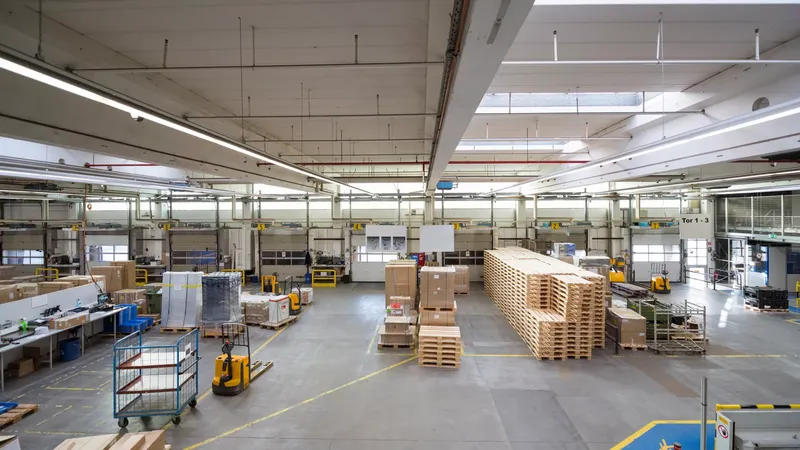
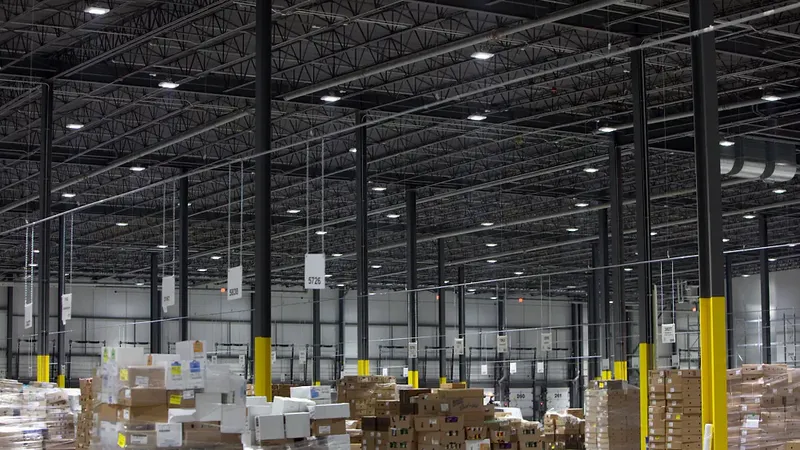
Warehouse LED high bay lights should be selected for the work being done, not simply for ceiling height or a replacement wattage. Storage, picking, packing and vehicle routes present different visual tasks. A floor that looks bright can still leave rack labels difficult to read or create glare for forklift drivers.
Record building dimensions, rack height, aisle width, mounting positions, daylight openings and working hours before requesting a quotation. Agree the applicable local lighting requirements and assessment planes. UK HSE guidance treats lighting as a workplace safety consideration; its recommendations should not be presented as one universal lux requirement for every warehouse.

2. Compare Distribution Before Fixture Shape
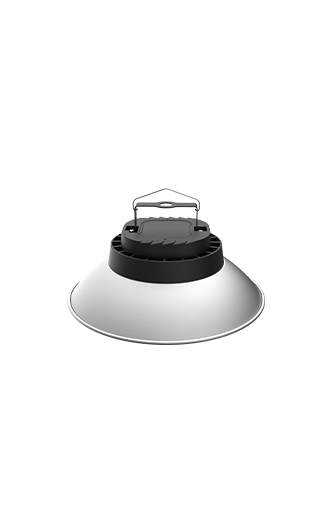
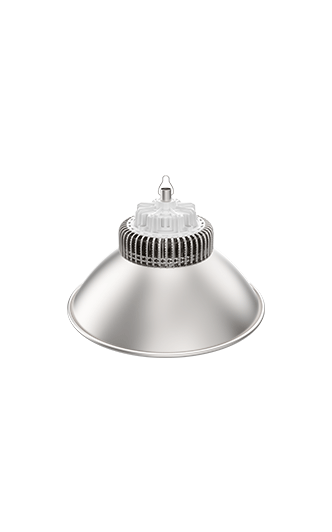
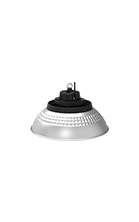
Linear luminaires can suit long aisles, while compact circular or UFO units offer convenient point mounting. UFO and round high bays are overlapping descriptions, not separate performance classes. Neither shape guarantees uniform illumination. The photometric distribution, rack geometry and spacing determine where the light actually reaches.
Narrower optics can concentrate light along an aisle but become more sensitive to position and aiming. Wider optics can improve open-area coverage while sending more light onto rack tops or into viewing directions. The distinction between high bay and low bay lighting is useful background, but mounting height alone cannot specify beam angle or wattage.

3. Estimate Fixture Count with Consistent Units
A first estimate is N = E × A / (Φ × UF × MF). Here E is maintained illuminance in lux, A is area in m², Φ is initial luminaire output in lumens, UF is utilisation factor and MF is maintenance factor. If using foot-candles, use a consistent area unit: 1 foot-candle is approximately 10.764 lux.
Consider an illustrative 600 m² open area at an assumed 300 lx, UF 0.60 and MF 0.80. The output values below come from current Uranus S built-in-driver specifications. The target and factors are assumptions, not a warehouse standard or measured project.
| Published option / initial output | Calculated count, rounded up | Connected load |
|---|---|---|
| 100 W / 14,000 lm | 27 | 2.7 kW |
| 150 W / 21,000 lm | 18 | 2.7 kW |
| 200 W / 28,000 lm | 14 | 2.8 kW |
On smaller screens, swipe within the table to view all columns.
For the 150 W option, 180,000 / 10,080 = 17.86, rounded to 18 luminaires. These counts estimate average light only. They do not prove rack-face illumination, glare or uniformity. Use the fixture-count and layout method with a photometric model before finalising positions.
4. Check Colour, Glare and Environmental Conditions
Lumens describe emitted light; lux describes light arriving at a surface. Colour rendering index (CRI) concerns colour fidelity, while correlated colour temperature describes the apparent warm or cool tone. Choose these for label reading, inspection and the surrounding environment. A higher colour temperature does not automatically improve visibility or save energy.
Compare exact product configurations. Bright Moon high bays list 60°, 90° and 120° optics. The Gaia S high bay lists IP20, which should not be treated as equivalent to a sealed fitting for wet cleaning. Verify the chosen model’s ingress protection, ambient-temperature limits, driver arrangement and mounting instructions.

5. Calculate Energy Savings from the Operating Schedule
Connected load and energy consumption are different quantities. In the illustrative 18 × 150 W layout, 2.7 kW operated for 4,000 hours consumes 10,800 kWh before any separately accounted auxiliary demand. A saving percentage requires a documented baseline, equivalent lighting requirements and realistic operating hours.
Occupancy control, scheduling and daylight-linked dimming can reduce demand, but driver compatibility and sensor coverage matter. Racks may obstruct detection, and switching must not leave occupied routes inadequately lit. Confirm zoning, dimming response and commissioning settings instead of assuming every dimmable driver supports the same control protocol.
6. Plan Installation and Maintenance Access
Check structural fixing points, approved suspension accessories, supply compatibility and safe service access. High bay equipment is not automatically suitable for recessed mounting, hazardous atmospheres or every production environment. Installation should follow the exact product instructions and applicable electrical requirements, with competent personnel responsible for the work.
Dust on optics reduces useful output and can affect cooling. Record cleaning intervals, driver replacement access and warranty responsibilities. A published LED lifetime is not a guarantee that the complete driver and luminaire will remain fault-free for that period. For rebate programmes, confirm the exact model’s current eligibility rather than accepting a generic claim about the brand.

7. Use Project Evidence and Measured Acceptance
CPS Lighting’s Sitong indoor-hall retrofit reports replacing 132 units rated 200 W with 102 units rated 150 W. The published counts imply connected load falling from 26.4 kW to 15.3 kW, approximately 42%. This is an indoor sports project, not a warehouse energy-saving guarantee.
For your warehouse, model actual racks, reflectances and photometric files. Check maintained horizontal illumination, vertical rack-face light, uniformity and glare from relevant viewing positions. At handover, measure agreed planes and test occupied, dimmed and daylight conditions. Keep the simulation, settings and measurement record together so later maintenance can be judged against the original brief.
8. Technical Sources
Product values are published manufacturer data; the fixture-count and annual-energy examples use explicit assumptions. Confirm the applicable local design requirements before specifying a project.
1. HSE: Lighting at work (HSG38)
2. CPS product specifications and the measured project record are linked in the relevant sections.
Core Keywords:
warehouse LED high bay lights, warehouse lighting design, high bay optics, LED high bay fixture count, maintained illuminance, industrial lighting controls