Contents
1. The Field Symptom: Loss of Contrast
2. How GR Describes Outdoor Stadium Glare
3. Optical and Mechanical Controls
4. Mounting Geometry and Performance Limits
5. Simulation and Commissioning Workflow
1. The Field Symptom: Loss of Contrast

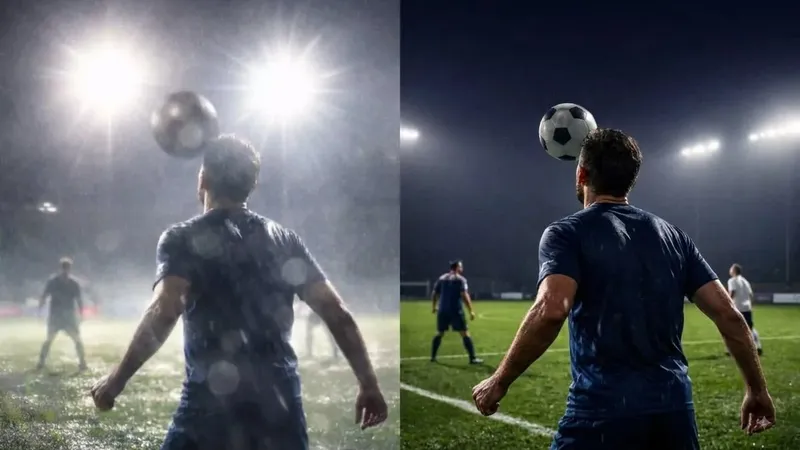
Consider a goalkeeper tracking a high cross during a night match. The pitch may satisfy its average lux target, yet one floodlight array can still enter the same sightline as the ball. The source then raises veiling luminance inside the eye, reduces object-to-background contrast, and delays visual recognition. The operational problem is therefore not insufficient light. It is uncontrolled light at a critical viewing angle.
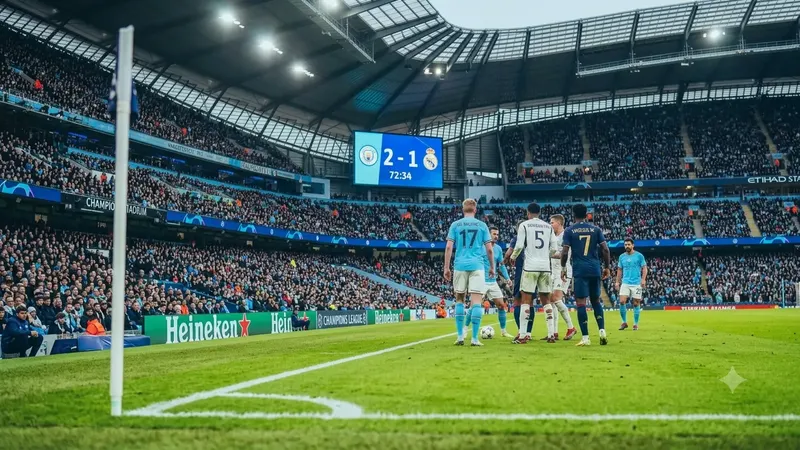
This distinction separates football stadium lighting engineering from basic area illumination. Horizontal illuminance describes light reaching the turf, while source luminance and beam direction determine how severe the installation appears to a player or camera. A compliant design must deliver usable Eh and Ev without creating glare around goals, touchlines, or aerial-ball sightlines.
2. How GR Describes Outdoor Stadium Glare
Outdoor sports projects use Glare Rating (GR), based on CIE 112, rather than treating visual comfort as a subjective site complaint. The assessment compares veiling luminance produced by the luminaires with the equivalent veiling luminance of the illuminated environment. The scale runs from 10 to 90, and a lower value indicates better glare restriction. CIE also states that the method is intended for viewing directions below eye level.
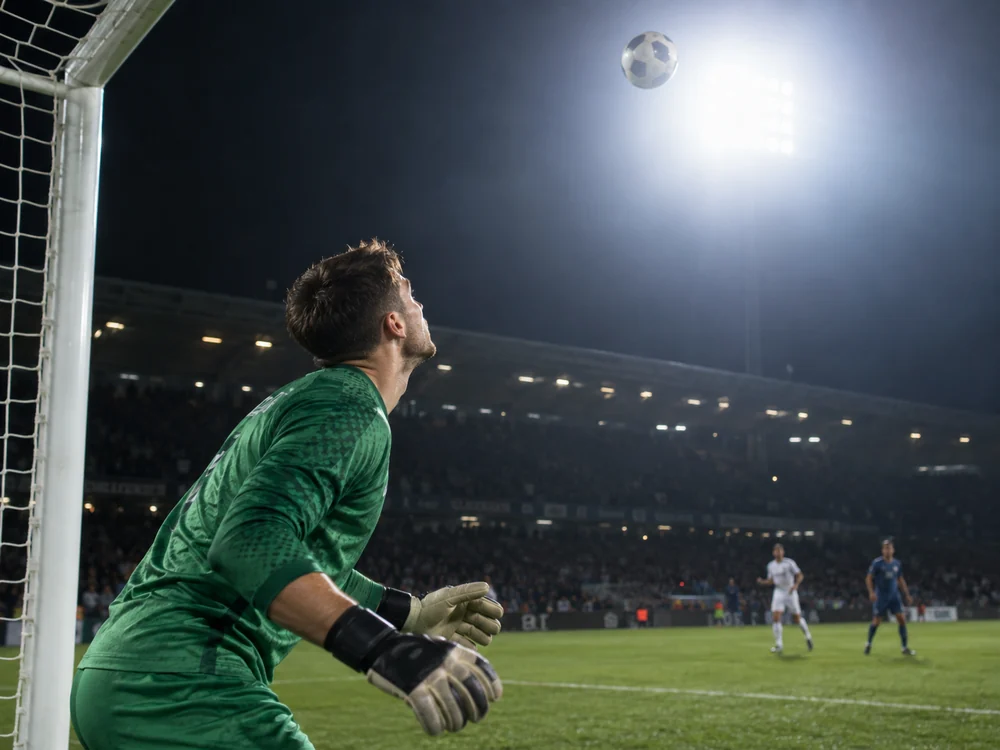
GR is sensitive to luminous intensity distribution, mounting height, luminaire count, aiming direction, and background brightness. Increasing wattage can raise pitch illuminance and worsen glare at the same time. The design must therefore assess GR together with horizontal and vertical illuminance, uniformity, camera flare, and spill light.
| Engineering indicator | UEFA Elite Level A value | What the value controls |
|---|---|---|
| Average horizontal illuminance, Eh | >2,000 lx | General pitch brightness |
| Horizontal uniformity, U1h / U2h | >0.50 / >0.70 | Dark zones and luminance transitions |
| Average vertical illuminance, Ev | >1,500 lx on four planes | Player modelling and camera exposure |
| Glare Rating, GR | <50 | Discomfort and contrast loss |
| Flicker factor | Average and maximum <3% | High-speed camera stability |
3. Optical and Mechanical Controls
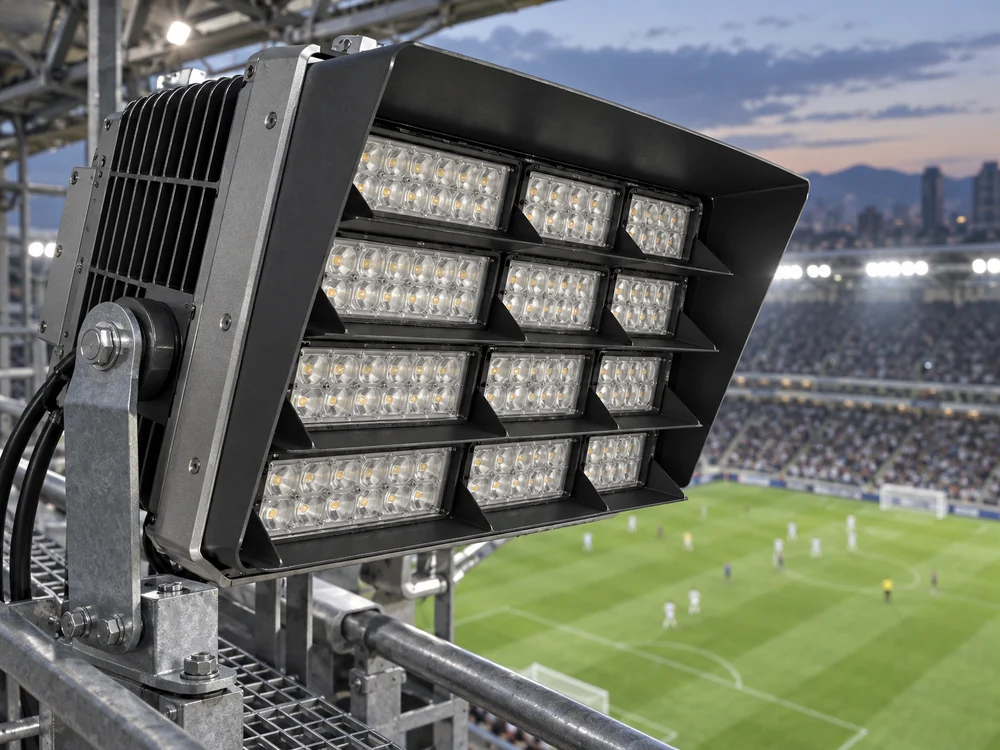
The optical system must place candela where the field requires it and suppress intensity outside the target zone. TIR lenses and shaped reflectors define the main beam. An asymmetric distribution can project light forward while keeping the luminaire face closer to a low-tilt position. This reduces direct source exposure, but only when the selected beam matches the mounting height and throw distance.
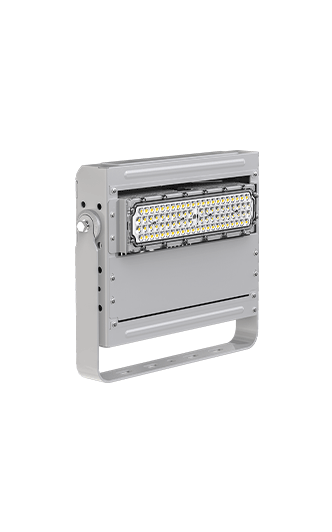
Mechanical shielding controls the remaining high-angle light. Visors, side shields, louvers, and recessed LED modules create a physical cut-off, yet each component also absorbs useful flux and can increase thermal loading. Products such as the Sirius Projection Light 1200W and Dubhe Projection Light 1000W provide optical and shielding options, but hardware cannot compensate for unsuitable pole positions or aiming coordinates.
4. Mounting Geometry and Performance Limits
UEFA guidance places pitch-perimeter luminaires between 25° and 45° above the pitch centre and recommends, where practical, a mounting height of at least 20–25 m. For flat-panel LED luminaires, limiting the focus angle to 60° from the perpendicular can help keep discomfort glare below GR 50. These are design constraints, not substitutes for a calculated glare assessment.
Higher mounting positions can separate the source from common player sightlines, but they increase beam length, pole moment, aiming sensitivity, and structural cost. Lower positions reduce structural demand but can expose the LED aperture and create stronger near-field gradients. Engineers must balance optics, mast geometry, wind loading, access, vertical illuminance, and the viewpoints behind both goals.
5. Simulation and Commissioning Workflow
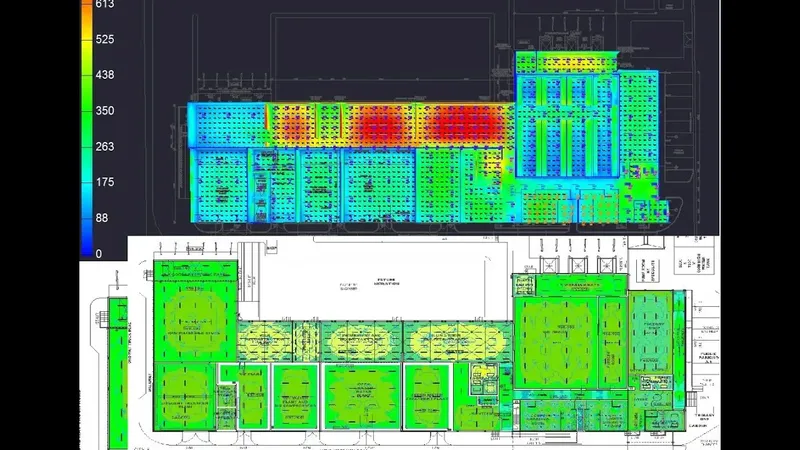
A defensible design starts with verified IES or LDT photometric files and exact pole coordinates. A DIALux or AGi32 model should calculate Eh, Ev, U1, U2, GR, spill light, and camera-facing planes for each operating mode. UEFA calls for glare assessment at all 96 reference grid points, at an observer height of 1.75 m, with viewing directions checked every 15° through 360°.
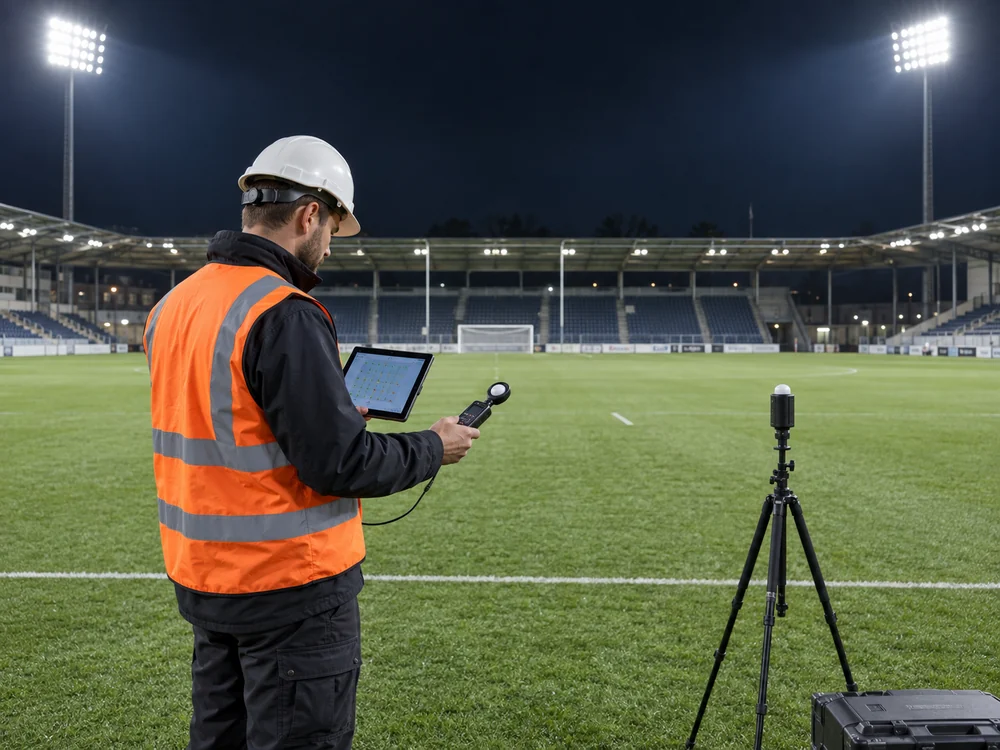
Commissioning must then test the installed system rather than assume that construction matches the model. The team should verify luminaire pan and tilt, calibrated meter status, grid illuminance, camera planes, goal-area sightlines, and control modes. The final report should preserve measured values and the aiming schedule so maintenance teams can detect later drift.
6. Retrofit Evidence and Engineering Decisions
The current CPS FIFA Grade A outdoor retrofit listing identifies Zhejiang Jinlin Sports Center as a 36,000 m² venue with 25,000 seats. It also records 200–1200W Sirius projection lights and DIALux or AGi32 design support. These facts describe that project’s scale and equipment range; they do not establish a universal GR, power-saving rate, or fixture count for other stadiums.
For a new project, the procurement decision should therefore require more than a nominal wattage and beam angle. The submittal should include accredited photometric data, the calculation grid, observer directions, GR maxima, camera-facing Ev, maintenance factor, aiming coordinates, shielding schedule, and structural loading. Anti-glare stadium lighting is proven when the optical model, installed geometry, and measured field result agree.
7. Technical Sources
1. UEFA Stadium Lighting Guide 2023: Evaluating glare
2. UEFA Elite Level A floodlight illuminance
3. UEFA pitch-perimeter luminaire mounting zone
4. CIE 112-1994 glare evaluation for outdoor sport
Core Keywords:
football stadium lights, stadium glare, anti-glare stadium lighting, Glare Rating, GR, LED sports lighting, asymmetric optics, floodlight aiming, vertical illuminance, lighting uniformity, photometric simulation, stadium lighting commissioning