CAMPUS BASKETBALL LIGHTING RETROFIT
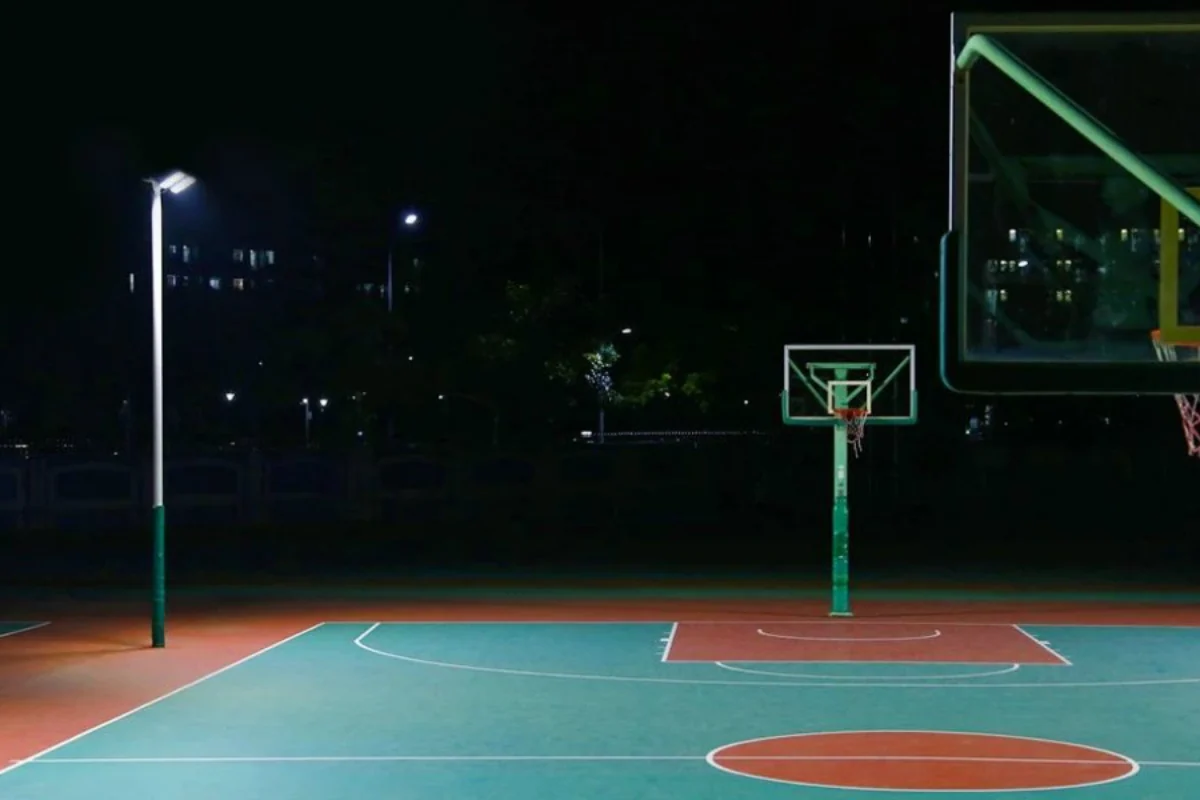
CPS Lighting designs and supplies sports lighting systems. At Bao’an District Middle School in Shenzhen, China, CPS supplied 12 × 200 W CPS Blue Elite Series luminaires to replace ageing outdoor basketball court lighting in a six-point symmetrical layout.
The upgrade addressed declining light output and recurring maintenance while supporting student practice, staff recreation and amateur basketball games. The project record reports 600 lx average illuminance after renovation. The combined rated power remains 2.4 kW, the same as the original system.
Send your court dimensions and mounting details. The simulation depends on the supplied inputs; final performance needs on-site verification.
12 × 200 W
Installed project configuration
6 points
Symmetrical lighting layout
600 lx
Reported average illuminance
1. The school’s brief and installed configuration
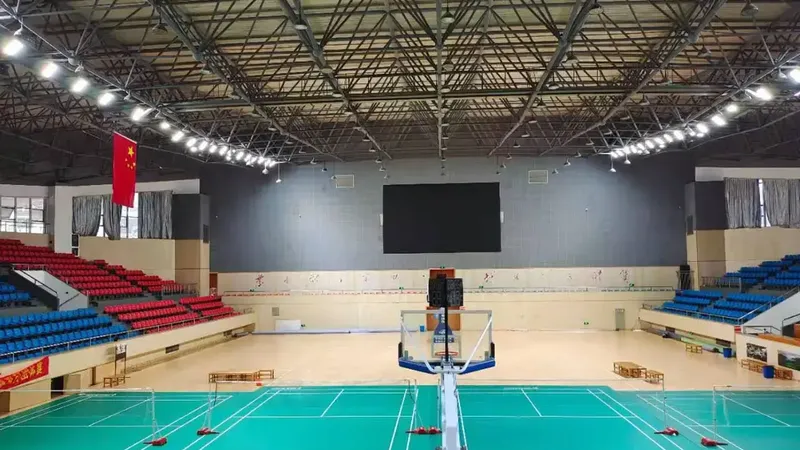
The court also accommodates school assemblies and campus activities. Its six ordinary 400 W LED lamps were reported to suffer from output loss and frequent failures, requiring maintenance at least twice a year. The school wanted more consistent court lighting and less maintenance disruption.
The supplied configuration identifies the replacement as CPS Blue Elite Series. It does not provide a historical order code, pole height or exact aiming angles. The six-point description therefore establishes the layout concept without defining a complete installation drawing.
| Project item | Original lighting | Renovated lighting |
|---|---|---|
| Luminaires | 6 × 400 W ordinary LEDs | 12 × 200 W CPS Blue Elite Series |
| Combined rated power | 2.4 kW, calculated | 2.4 kW, calculated |
| Layout | Mounting details not documented | Six-point symmetrical arrangement |
| Maintenance | At least two interventions a year, reported | Lower maintenance was a project goal; no follow-up log supplied |
On narrow screens, swipe the configuration table horizontally.
2. Distribute light for basketball sightlines
This retrofit changes how the rated power is distributed: twelve lower-power luminaires replace six higher-power units. That gives more scope to direct overlapping beams across the playing area. Actual uniformity still depends on mounting positions, optical distribution and aiming; fixture count alone cannot establish the result.
Basketball players look upward during shots and rebounds. For a similar court, beam directions should be checked from both baskets, the key and the sidelines to limit direct glare while maintaining coverage. The campus setting also makes light spill toward nearby buildings a relevant design check.

Watch the original CPS project video.
3. What the reported results establish
The case record states an average illuminance of 600 lx. The original comparison graphic labels the CPS view as 600 lx and another-brand view as 350 lx. These are source-reported values: the supplied material does not include the measurement grid, meter record or test conditions needed for independent verification.

Photographs illustrate the court and installation; their brightness is affected by exposure and viewing conditions. They do not establish a measured before-and-after improvement. Average illuminance also does not replace checks of uniformity, glare or colour rendering. The original brief targeted Grade II training use, but the available evidence is insufficient to confirm full compliance.
The rated-power calculation is 6 × 400 W = 12 × 200 W = 2,400 W. It is calculated connected luminaire power, not metered site demand. Annual energy savings and maintenance savings cannot be quantified without operating hours, control settings, measured consumption and follow-up records.
4. CPS design, supply and quality support
For this project, the record supports CPS’s lighting renovation solution, fixture supply and six-point layout. It does not establish who performed the electrical installation or document a separate commissioning service.
For new projects, CPS can combine optical planning with luminaire selection. Its manufacturing capabilities include metal processing, finishing and assembly. Its laboratory equipment covers photometric, electrical safety and environmental testing. These capabilities support product evaluation; equipment listings alone do not prove a particular installed batch passed every test.
5. Installed product and current selection reference
Installed project configuration: CPS Blue Elite Series, 12 × 200 W, 2.4 kW combined rated power. The historical model code remains unconfirmed.

Current catalogue reference for a new project; it is not confirmed as the historical Blue Elite model.
| Catalogue item | Published value |
|---|---|
| Rated power | 200 W |
| Luminous flux | 30,000 lm |
| Colour temperature / rendering | 5700 K / Ra ≥ 80 |
| Beam angle | 45° |
| Ingress protection | IP66 |
Catalogue output and optical values describe the current reference product, not measurements from this school. A replacement specification should be checked against the actual mounting geometry and required court performance.
6. Plan your school court retrofit
Send CPS a site plan or computer-aided design (CAD) drawing, or court dimensions; the sports and intended level of play; pole locations and heights; photographs; and the project location. For a retrofit, include existing fixture ratings, operating hours and any available measurements. These inputs help assess layout options, installation constraints and the basis for a meaningful comparison.
Send your court dimensions and mounting details. The simulation depends on the supplied inputs; final performance needs on-site verification.