CPS Lighting supplies LED floodlighting and design support for large outdoor sites. At Hangzhou Xiaoshan International Airport in Zhejiang, China, the published CPS project account credits its wholly owned subsidiary, Jiongda Energy Technology, with delivering a phased apron-lighting retrofit under an energy management contract.
Phase two covered 1,149 high-mast luminaires. The account reports total lighting power falling from 1,103.4 kW to 459.6 kW, alongside higher aircraft-stand illuminance. The upgrade paired a lower reported electrical load with improved illumination of aircraft stands.

Luminaires in phase two
Reported post-retrofit total power
Reported average aircraft-stand illuminance
1. A phased apron-lighting upgrade
The work addressed high-mast apron floodlighting. An earlier phase co vered 248 luminaires on Apron 2. The second phase then extended the upgrade to four further apron areas; the 248 earlier units are not included in its 1,149-light schedule.
| Phase-two area | Luminaire count |
|---|---|
| Apron 3 | 377 |
| Apron 6 | 288 |
| Apron 7 | 143 |
| Apron 9 | 341 |
| Phase-two total | 1,149 |
The published delivery model was an energy management contract (EMC), with a four-month retrofit period and an eight-year operating term. These are historical project terms, not a standard schedule or contract offer for new customers.


2. Lower power and reported lighting results
The existing phase-two installation comprised 1,073 high-pressure sodium luminaires rated at 1,000 W and 76 rated at 400 W. The listed ratings sum to 1,103.4 kW. After the LED retrofit, the reported total was 459.6 kW.
| Item | Published project figure |
|---|---|
| Existing configuration | 1,073 × 1,000 W + 76 × 400 W |
| Total power before / after | 1,103.4 kW / 459.6 kW |
| Average aircraft-stand illuminance before / after | 20 lx / above 40 lx |
| Post-retrofit uniformity | Approximately 0.4; ratio definition not published |
The difference is 643.8 kW, or a 58.35% reduction in listed power, calculated as (1,103.4 − 459.6) ÷ 1,103.4. This calculation is separate from the account’s report of measured electricity savings above 58%. Annual kilowatt-hour savings cannot be established without the operating schedule and metering basis.
The account also reports successful acceptance and improved aircraft-stand illumination. The full measurement grid, uniformity formula, operating scene and acceptance documentation are not published. The figures should therefore remain attributed project results, rather than independent verification or proof of compliance with a named aviation standard.


For a comparable apron, useful light must reach the required working areas without relying on average illuminance alone. Existing mast positions, boarding bridges and aircraft can affect light distribution and shadowing. A proposed layout should be reviewed against the airport’s brief, with aiming and relevant viewpoints checked during commissioning.
3. Energy-service delivery and CPS resources
The original case identifies Jiongda Energy Technology as the energy-service provider for both phases. The contract linked equipment replacement with a defined operating term, making energy-service responsibility a central part of the project scope.
For new projects, CPS’s manufacturing resources include machining, finishing and assembly, while its laboratory equipment supports electrical, optical and reliability checks. Model-specific reports and the proposed service scope should accompany the quotation; general factory capabilities do not establish airport approval.
4. Project configuration and current selection reference
The published case does not identify the installed LED model or provide a per-model wattage schedule. Dividing 459.6 kW by 1,149 gives 400 W per luminaire on average, but this does not prove that every installed unit was a 400W model.

Installed project configuration
| Parameter | Project configuration or catalogue reference |
|---|---|
| Application | Phase-two high-mast apron lighting |
| Published scope | 1,149 luminaires across Aprons 3, 6, 7 and 9 |
| Reported LED total power | 459.6 kW |
| Historical product identification | Exact LED model and individual power allocation are not published. |
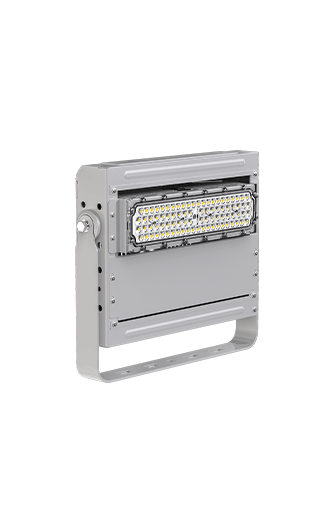
The Polaris TS-BJX modular floodlight is a current high-power outdoor product reference for an initial design discussion. It is not identified as the historical airport luminaire. Its published catalogue does not establish approval for this airport; suitability requires project-specific optical, mechanical and operational review.

Polaris TS-BJX — current catalogue reference
| Parameter | Project configuration or catalogue reference |
|---|---|
| Catalogue power range | 100 / 200 / 300 / 500 / 1,000 / 1,500 W |
| Input voltage | AC 120–277 V |
| Colour-temperature options | 3000 / 4000 / 5000 / 5700 K |
| Enclosure rating | IP66 |
| Selection boundary | Current catalogue only; not the confirmed installed airport model. |
5. Plan an apron-lighting retrofit
Send an apron plan or CAD drawing, mast positions and heights, stand layouts, boarding-bridge locations and relevant obstructions. Include the existing luminaire schedule, measured power, operating hours and available lighting reports. Provide the project location and the airport’s lighting criteria, access restrictions and maintenance requirements.
Request a free DIALux simulation to compare a proposed layout. Calculations require agreed geometry and configuration-specific photometric data. Confirm installation access, aiming, measurement procedures and airport acceptance requirements separately before implementation.