Outdoor Tennis Court lighting for Evening Play
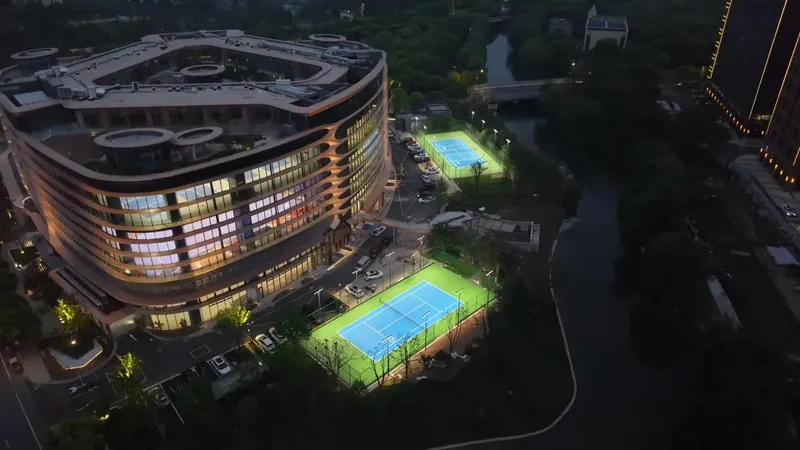
CPS Lighting designs and supplies LED tennis court lighting systems. At Zhoujiazhuang Sports Park in Beijing, the tennis courts formed part of a wider outdoor lighting project serving community sport and amateur competition.
The case brings together court photographs, a reported lighting-performance summary and a modular floodlight schedule. For your own facility, CPS offers free DIALux lighting simulation to review the layout before fixture selection.

>500 lx
Reported court average
Tennis and basketball grouped in the source summary.
Grade II
Project classification
CPS’s stated amateur-match and training brief.
>40,000 m²
Wider park area
Not the tennis-court area alone.
1. Lighting the tennis courts, not just the park
The original brief described uneven brightness, glare and spill from an ageing outdoor lighting system. For tennis, these issues matter beyond the white court lines: players follow a small, fast-moving ball and look upward during serves and lobs.
A tennis court lighting layout therefore needs to cover the playing surface and surrounding run-off areas while keeping bright sources out of frequent viewing directions. The supplied daytime photograph shows the court arrangement and perimeter lighting positions; it helps explain the physical setting behind the night view.

CPS’s project covered other park facilities as well, but the tennis courts are the focus here. Their lighting needs should be assessed on a tennis-specific grid, not assumed to be identical to those of an adjacent football pitch.
2. Reported tennis lighting performance
The CPS record identifies a Grade II project brief under JGJ 153-2016. Its performance summary groups basketball and tennis together and reports the following values. They are case-reported results, not independent certification or a substitute for a court-by-court measurement report.
| Metric | CPS case summary | What a buyer should check |
|---|---|---|
| Average illuminance: tennis / basketball | >500 lx | Coverage of the court and relevant surrounding area |
| Uniformity: tennis / basketball | >0.6 | Calculation grid and the exact ratio used |
| Glare Rating (GR): project summary | <50 | Player viewing directions and luminaire aiming |
Source: original CPS performance summary. The source does not define the uniformity ratio or provide individual tennis-court measurement grids.
Average illuminance describes overall brightness, while uniformity describes how evenly light is distributed. Glare Rating estimates discomfort from bright sources in a specified outdoor viewing arrangement. A convincing tennis lighting proposal should consider all three rather than pursue more lux alone.
For tournament use, agree the governing body’s requirements separately. The ITF facilities guidance is a tennis-specific reference; this park’s Grade II description does not establish ITF tournament approval or television-broadcast compliance.
3. Modular floodlights and product selection
The project equipment schedule lists 300W and 600W modular LED sports floodlights, together with DMX control. Across the whole park, it records 60 units at 300W and 216 units at 600W; it does not allocate those quantities to the tennis courts individually.
For a new tennis court lighting project, wattage is only a starting point. Pole height, spacing, beam distribution and aiming determine where the light reaches. A higher-powered fixture may increase average brightness without improving a dark baseline or reducing glare.
The current Dubhe 300W and Dubhe 500W modular floodlights below are catalogue options for a new proposal, not photographs identifying the exact historical 600W project model. Select the power and optics from the court layout rather than from appearance alone.


Catalogue images are presented at comparable display sizes, not as physical-scale comparisons.
4. Tennis within the wider park layout
The surrounding park includes basketball, football and roller-sport facilities. The lighting scheme must serve those areas without allowing their beams to dominate the tennis courts or nearby buildings. Separate aiming and operating zones help keep the tennis layout purposeful.
The original schedule includes a DMX control system. For your project, define which courts can switch or dim independently, the operating timetable and the response to a control fault. Savings depend on actual operating hours and dimming levels; no percentage is inferred from the presence of DMX alone.


5. What CPS provides to a lighting buyer
CPS combines lighting design, luminaire supply and installation support. Buyers can review its company and manufacturing profile and lighting testing laboratory when assessing a tennis lighting supplier, then request the photometric files and test documentation for the proposed model.
The OEM/ODM service provides a route for discussing configuration and manufacturing requirements. Confirm the specified driver, control interface, outdoor protection rating, mounting arrangement and warranty in the quotation. Installation responsibilities should also be clear, particularly for overseas projects.
The park’s community role is independently documented: the Beijing Municipal Bureau of Sports recorded Zhoujiazhuang as one of the venues for the first Beijing Flying Disc Open in 2022. That verifies its event use, not tennis-lighting acceptance. The original CPS case video is retained for further project context.
6. Start your tennis court lighting proposal
Planning LED tennis court lighting for a club, school or sports park? Send CPS the number of courts, a dimensioned layout, existing or proposed pole heights, intended level of play and project location.
Request a free DIALux lighting simulation to review court coverage and suitable floodlight options. Include surrounding buildings, run-off areas and operating requirements so the proposal can address your site rather than copy another court’s wattage.
Email: info-cps@cps-lighting.com