Contents
2. Define Measurable Performance
3. Turn the Requirement Into a Layout
4. Compare Risks and Responses
1.Start With the Visual Task

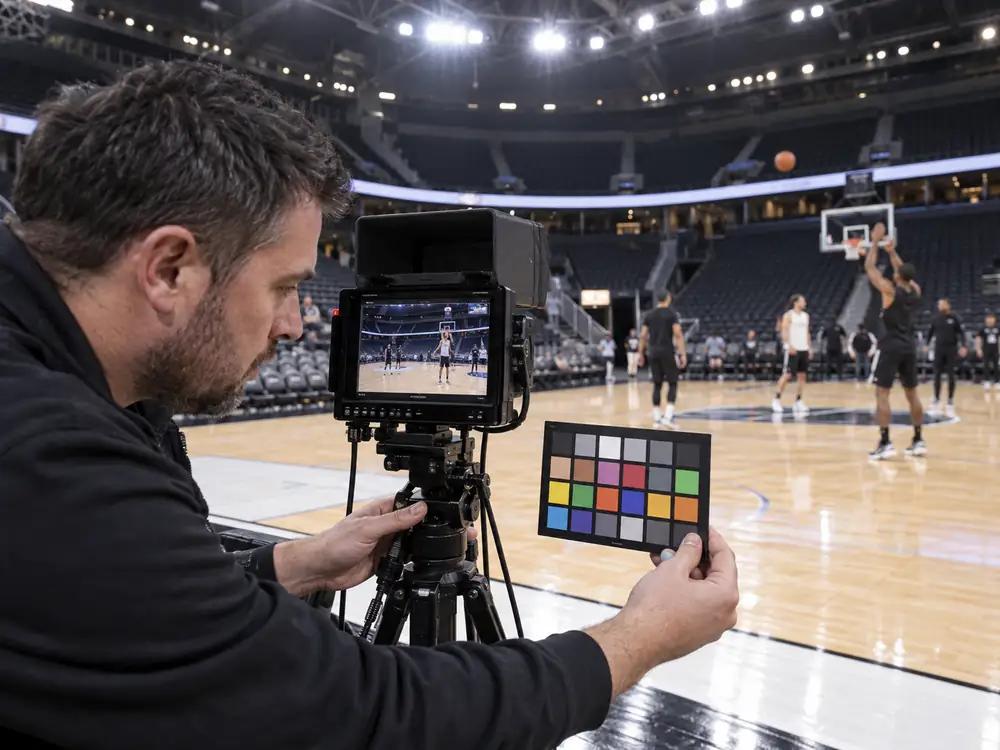
A jersey may look correct to spectators but shift toward green or magenta on a television camera. The cause is not only color temperature. The spectral output of the LEDs, camera white balance, dimming level, and reflected court color all affect the final image.
This field condition explains why basketball broadcast lighting must be designed around people, cameras, and operating modes. A single catalogue value cannot describe the full result. The project team needs a written brief before it compares wattage, fixture count, or purchase price.
2.Define Measurable Performance
FIBA recommends a color rendering index of at least Ra 80 and a correlated color temperature from 4,000 K to 6,000 K. Broadcast projects should also review TLCI or camera tests because CRI does not describe every camera response. A tight fixture-to-fixture color tolerance also prevents visible patches across the court.
The calculation should use verified IES or LDT data and maintained values. FIBA separates the 19 m × 32 m Principal Playing Area from the 22 m × 35 m Total Playing Area. This wider calculation prevents a bright centre court from hiding weak benches, run-off zones, or camera backgrounds.
3.Turn the Requirement Into a Layout
Designers should compare spectral data, R9 performance, chromaticity tolerance, and dimming behavior. They should light faces and jerseys from useful vertical angles, then set camera white balance under the final operating scene. A high CRI label alone cannot repair weak vertical illumination or mixed lamp colors.
Engineers should test the design in DIALux or AGi32 with the real roof, baskets, scoreboards, cameras, and obstructions. They should compare horizontal illuminance, vertical illuminance, uniformity, glare, color, and flicker as relevant. Every adjustable fitting also needs an aiming reference that installers can reproduce.
4.Compare Risks and Responses
The table is a concept-stage guide, not a substitute for project calculations. The final response depends on the venue geometry, competition level, electrical system, structure, local law, and the selected luminaire. Changes to one item can affect several others, so the lighting, controls, structure, and broadcast teams should review the same coordinated model.
5.Model, Install, and Commission
A reliable workflow starts with a site survey and a signed performance brief. The designer models at least two practical layouts, issues a fixture and aiming schedule, and coordinates power, controls, access, and structure. During installation, the team records product codes, addresses, mounting positions, tilt, rotation, and any approved field change.
Commissioning must test the completed system, not a sample fitting. The team should measure the agreed grids, inspect critical player and camera views, run every control scene, and record abnormal results. Calibrated instruments, photos, control backups, and a final report create a useful baseline for cleaning, re-aiming, warranty work, and later upgrades.
The handover should also define inspection intervals, cleaning access, spare parts, responsible staff, and the trigger for new measurements. Courts change when scoreboards, curtains, seating, cameras, or roof services are added. A controlled change process keeps the approved lighting result from slowly being lost.
Good basketball broadcast lighting is therefore a controlled system rather than a high-output product choice. Clear targets, verified data, coordinated installation, and measured acceptance protect both game quality and long-term operating cost.