Contents
1. Choose CCT Around the Activity
2. Compare 3000K, 4000K, and 5000K
3. Keep Colour Rendering Separate
4. Avoid Unsupported Energy Claims
1.Choose CCT Around the Activity

Consider a gym with treadmills, a free-weight zone, and a stretching room. A single cool-white setting may make equipment labels clear but leave the quiet room looking harsh. A warmer setting may suit that room but alter the appearance of grey flooring. This is a design comparison, not proof that one colour makes people train harder.
Gym lighting color temperature describes the apparent warmth or coolness of white light in kelvin. Engineers should choose it alongside maintained illuminance, source brightness, room finishes, and operating hours. The visual task comes first: members must read settings, identify equipment, and see floor edges. CCT cannot replace adequate light.
2.Compare 3000K, 4000K, and 5000K
A 3000 K source has a warm-white appearance. A 4000 K source looks more neutral, while 5000 K looks cooler. These labels describe appearance, not light output or a mandatory fitness standard. A 4000 K sample is a useful starting point for a mixed-use gym, but the room mock-up should decide the final selection.
The comparison above gives project starting points. It does not set a universal gym lighting rule. Operators can use separate zones to support different activities, as discussed in the Yoga and Pilates lighting guide. Each zone still needs its own visibility and glare review.
3.Keep Colour Rendering Separate
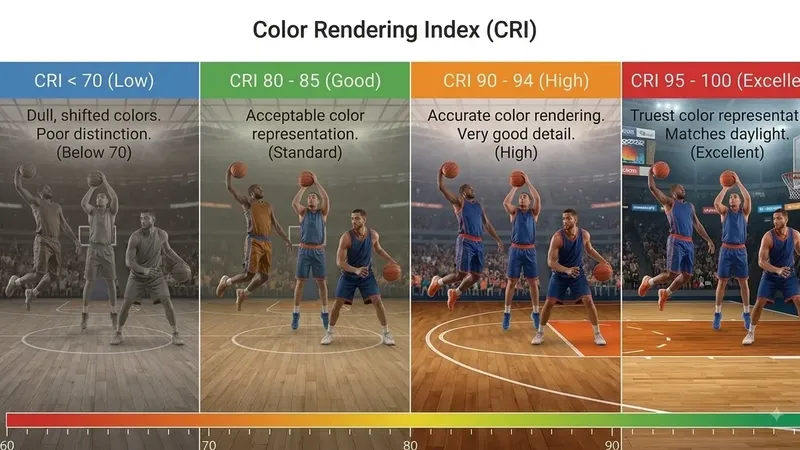
Two 4000 K LEDs can have different spectral power distributions. They may render skin, timber, clothing, and coloured equipment differently. A procurement brief should therefore specify CRI, the selected CCT, and colour consistency together. Ra ≥ 80 can be a project baseline; close-observation or premium spaces may justify Ra ≥ 90 after sample testing.
The CRI and TLCI guide introduces colour-quality checks. For a gym, camera-oriented metrics matter when filming is part of the brief. Engineers should also request a stated chromaticity tolerance, such as a project target of SDCM ≤ 3. These are design choices, not automatic guarantees of natural-looking colour.
4.Avoid Unsupported Energy Claims
A cooler appearance does not by itself prove greater alertness, workout efficiency, or calorie expenditure. The CIE 2024 integrative-lighting statement points to CIE S 026 for assessing non-visual light exposure. Such assessment requires spectral information and exposure at the eye; CCT alone is insufficient. Timing, duration, and light level also matter.
For a late-opening gym, a separate warm scene may support the intended atmosphere, but dimming must preserve useful visibility. The LED driver and flicker guide explains why temporal output needs its own review. A tunable-white system also needs compatible drivers, repeatable scenes, and a documented replacement policy.
5.Specify and Verify the Installed System
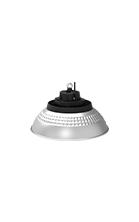
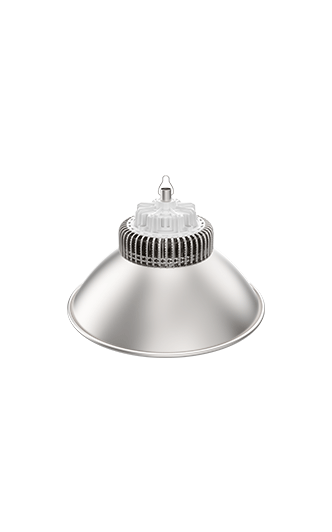
Product data should identify the actual available versions. The CPS Uranus high-bay light lists 3000 K, 4000 K, 5000 K, and 6500 K options with Ra ≥ 80. Those are selectable product variants. The listing does not establish that one fitting can tune between those values or suit every ceiling height.
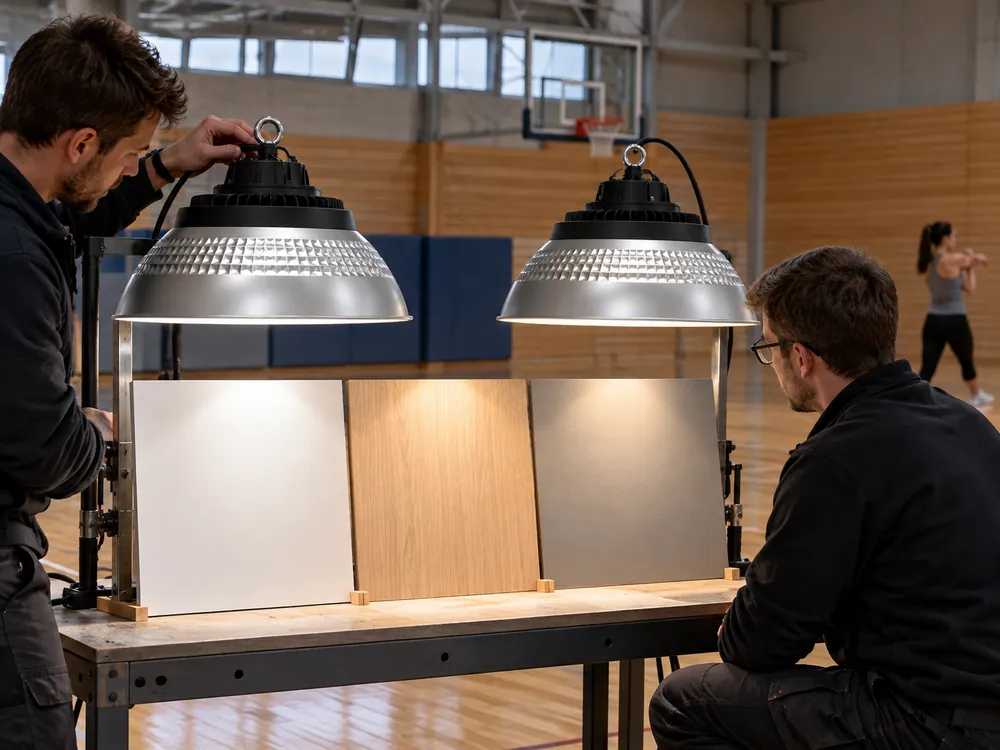
The final optical model should use the chosen version’s photometric file, room dimensions, reflectances, and maintenance assumptions. A sample review should then check equipment markings, skin tones, mirrors, and the dimmed scene. Engineers should record measured CCT and illuminance after thermal stabilisation, and check colour differences between adjacent fittings.
CPS reports an indoor multi-sport retrofit at Lanzhou Vocational College that addressed uneven light, glare, colour rendering, and flicker. That Grade III gymnasium case supports a complete design-and-commissioning workflow. It is not a controlled study of CCT and exercise performance. A sound LED gym lighting specification keeps those claims separate and records the evidence needed for future maintenance.