Contents
3. Why IK Matters for LED Sports Lights
4. How IK Testing Is Performed
5. Materials, Design, and Failure Modes
1. What an IK Rating Measures
An IK rating for LED lights classifies how an electrical enclosure resists an external mechanical impact. IEC 62262 defines the IK code from IK00 to IK10. Each code corresponds to a specified impact energy in joules, so it is more precise than describing a housing as merely “impact resistant.” The declaration applies to the tested enclosure, assembly, mounting condition and accessible surfaces covered by the test report.
IK and IP ratings answer different questions. IK addresses mechanical impact; IP addresses access, dust and water ingress under IEC 60529. A luminaire can have a strong housing but weak sealing, or excellent sealing but a lens that cracks under impact. CPS explains the environmental-sealing side separately in its IP rating guide for outdoor stadium lights.
2. IK00 to IK10 Impact Energy
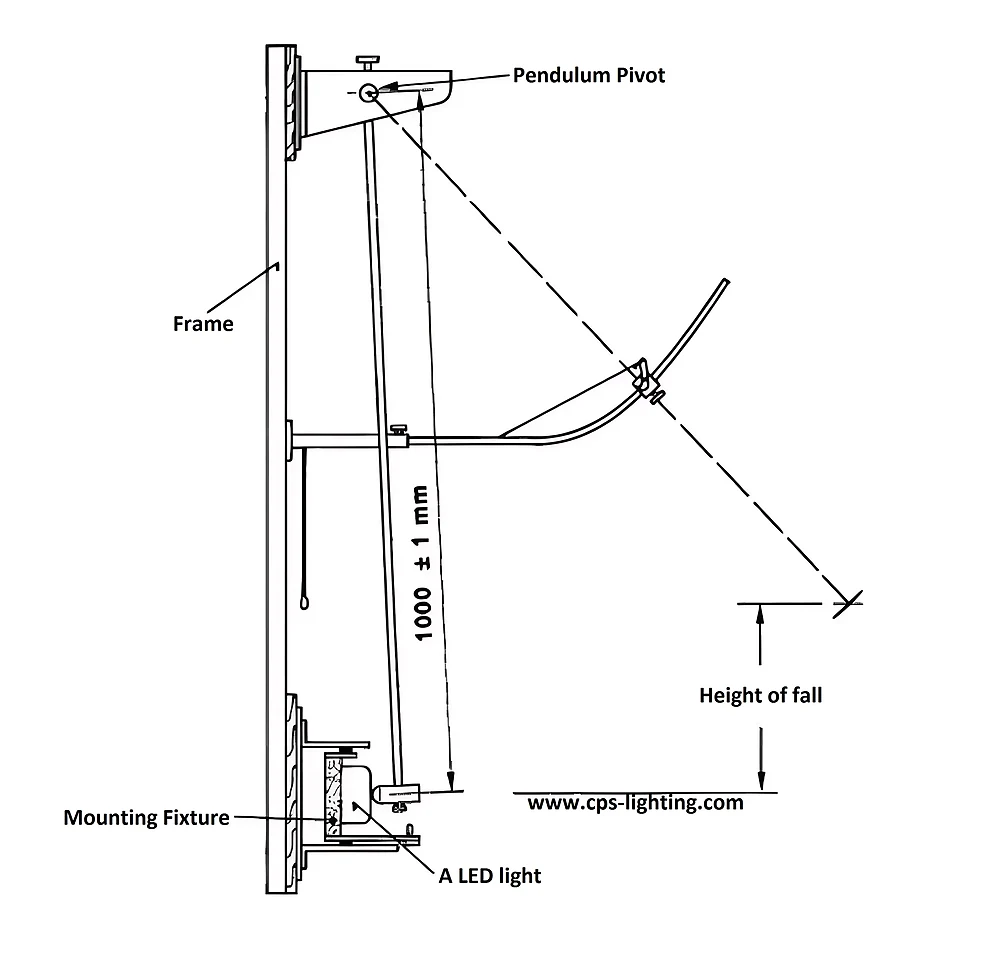
Impact energy can be expressed as E = m × g × h, where mass, gravitational acceleration and drop height determine the delivered energy. The equation helps explain the scale, but the formal result must come from the prescribed apparatus and procedure. A field impact that has the same nominal energy may load the enclosure differently because the contact shape, direction, support and impact duration are different.
3. Why IK Matters for LED Sports Lights
The correct rating depends on exposure, not on luminaire wattage. Low-mounted court lights, wall-mounted fittings, pedestrian-area luminaires and equipment near ball trajectories face different risks from high-mast floodlights. Possible hazards include a cracked lens, loose fragments, loss of electrical protection, changed beam distribution or failure of the mounting interface. A higher IK code can reduce risk, but it does not replace structural, vibration, corrosion or weather testing.
Project evidence must keep these requirements separate. For example, CPS reports an 18 m high-pole layout and more than 550 lx average illuminance for its Grade III football field project, but the published case does not state an IK value. No impact rating should be inferred from the optical result. Current housing and test data must be confirmed for the exact model selected from the CPS sports lighting product range.
4. How IK Testing Is Performed
IEC 60068-2-75 defines coordinated spring-hammer, pendulum-hammer and vertical-hammer methods covering prescribed impact severities. The suitable apparatus is selected according to the required energy, specimen geometry and applicable product standard. Therefore, the common shortcut “spring hammer for low IK and pendulum for high IK” is not a complete test specification.
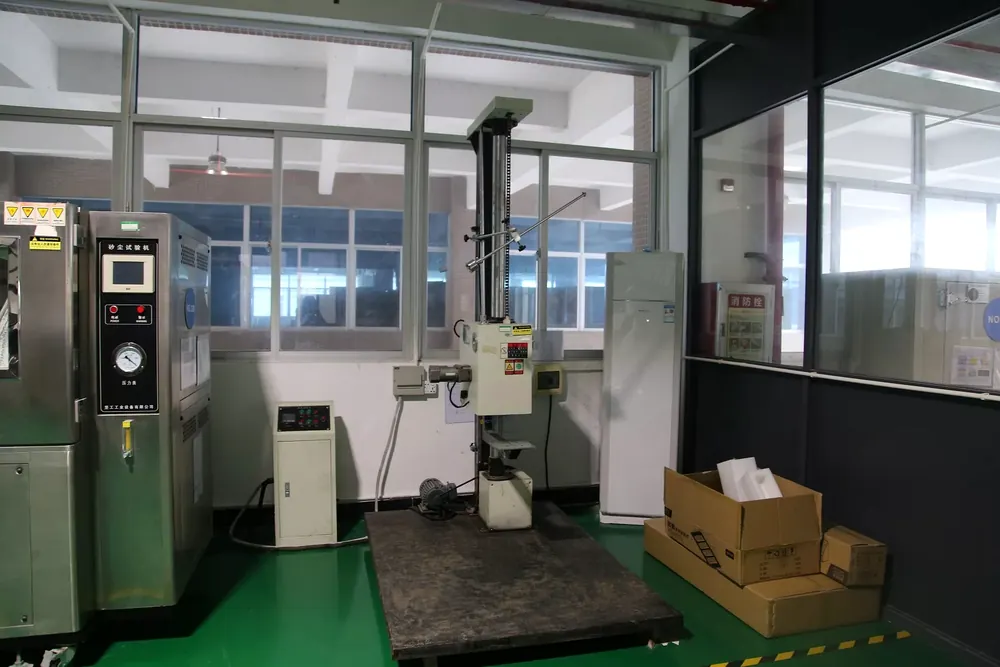
A useful report identifies the specimen, mounting, impact energy, number and position of impacts, test orientation and acceptance criteria. After testing, engineers inspect cracking, deformation, fasteners, lenses, seals and access to hazardous parts. Where the project requires continued ingress or electrical protection, those properties should also be verified after impact. The current CPS Lighting laboratory page lists an impact tester among its reliability equipment, but project submittals should still include evidence for the exact luminaire configuration.
5. Materials, Design, and Failure Modes
Impact performance comes from the complete assembly. Tempered glass offers optical stability and scratch resistance, while polycarbonate can absorb impact through controlled deformation. Die-cast aluminium supports the lens and transfers load into the housing. Thickness, ribs, curved surfaces, fastener spacing, gasket compression and bracket stiffness all affect how impact energy travels through the luminaire.
There are trade-offs. Thicker parts add weight and projected area; flexible polymers can improve impact resistance but require checks for ultraviolet ageing and optical change. A rigid lens may survive one load yet transfer stress to clips or seals. Impact resistance also says nothing by itself about salt fog, thermal cycling or vibration. These separate mechanisms are discussed in CPS’s extreme-environment luminaire engineering guide.
6. Selecting an IK Rating for the Application
Start with a site risk assessment: identify credible impact sources, accessible mounting heights, public contact, ball paths, maintenance tools and vandalism exposure. Then check the tender or product standard for a minimum code. IK08 or IK10 may appear in robust outdoor specifications, but neither is a universal requirement for every LED luminaire. Over-specifying the enclosure can increase mass, cost and structural load without addressing the project’s dominant failure mode.
Before approval, compare the declared code with the test report, model number, lens option, bracket and mounting method. Confirm what surfaces were tested and what constituted a pass. This turns the LED luminaire IK rating from a catalogue label into verifiable engineering evidence.
7. Technical Sources
1. IEC 62262: IK code classification
2. IEC 60068-2-75: hammer test methods
3. CPS Lighting laboratory equipment
Core Keywords:
IK rating for LED lights, IEC 62262, IEC 60068-2-75, LED luminaire impact resistance, IK08 lighting, IK10 lighting, sports lighting manufacturer, stadium flood light, impact testing