Contents
1. What High Bay Light Fixtures Are, and Why 6 m Matters
2. Fixture Generations: LED, HID, and Fluorescent Compared
3. Applications and Illuminance Targets
4. Selecting Fixtures and Checking the Layout
5. Installation and Commissioning
6. Maintenance and Real Retrofit Numbers

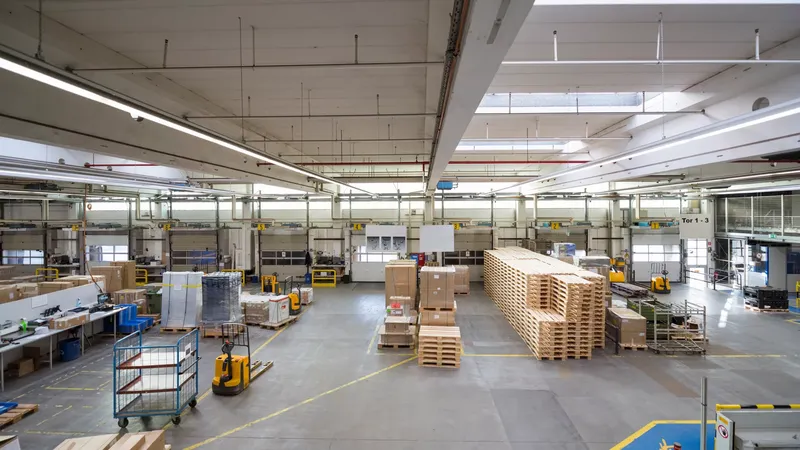
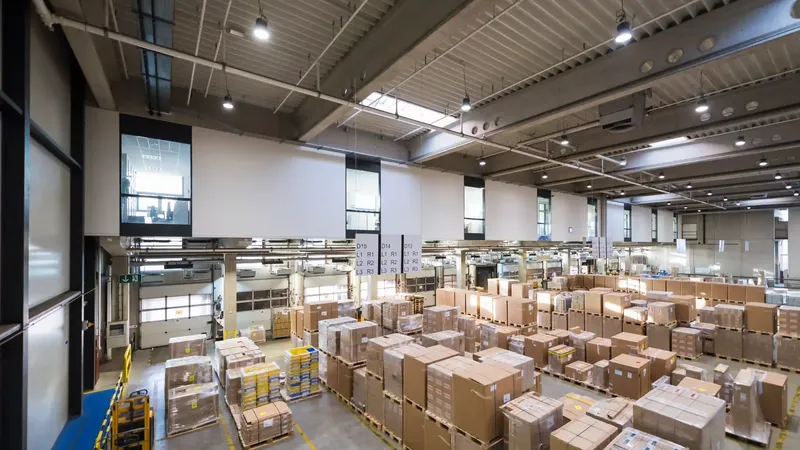
High bay light fixtures serve buildings where the ceiling sits far above the working plane: distribution centres, factories, hangars and indoor sports halls. Performance there is decided by maintained illuminance, mounting height, photometric distribution and maintenance factor.
1. What High Bay Light Fixtures Are, and Why 6 m Matters
High bay luminaires are engineered for ceilings at roughly 6 m and above, where reaching the working plane needs high luminous flux and a downward distribution. Below it, low bay or industrial luminaires trade peak intensity for wider coverage and better glare control at eye level. The 6 m line is a convention, not a legal limit, but it governs spacing-to-height ratio and achievable uniformity.
Two classifications get confused. High bay describes mounting geometry, not wattage. Separately, IES Type I to Type V classifies roadway and parking distributions; a symmetric high bay is not a Type V because it emits in all directions, and Type IV never describes an output level. Specify beam angles in degrees, not a Type label.
2. Fixture Generations: LED, HID, and Fluorescent Compared
| Luminaire family | Typical system wattage | Typical efficacy | Rated life | Practical notes |
|---|---|---|---|---|
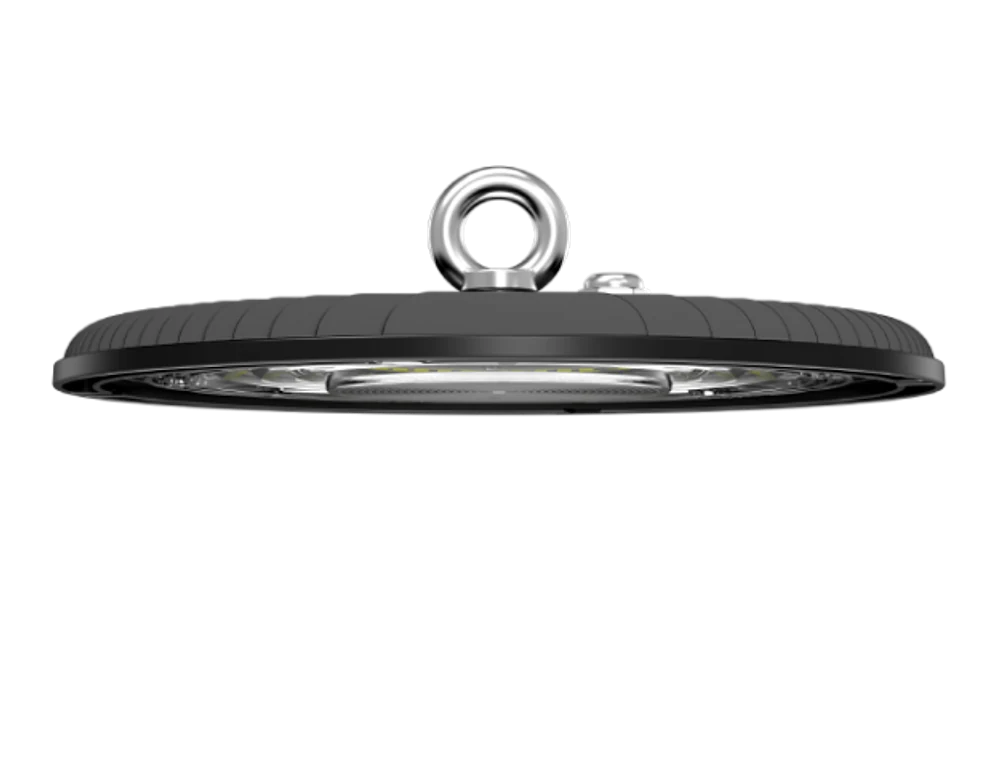
| LED high bay | 100–200 W for most 6–12 m buildings | 140–150 lm/W on current CPS high bays | 50,000 h to L70, with TM-21 projections naming the case temperature | Instant restart, dimmable, driver is the usual first failure point |
| HID (metal halide, high-pressure sodium) | 250–1,000 W per luminaire | Roughly 60–110 lm/W including ballast losses | 10,000–25,000 h, plus colour shift over life | Long warm-up and a restrike delay of several minutes after a power dip |
| Fluorescent high bay | 45–85 W per lamp, often multi-lamp | Roughly 70–90 lm/W at 25 °C | 20,000–30,000 h | Output falls in cold rooms; mercury content limits disposal routes |
The table explains why retrofits are quantified in watts: a 150 W LED high bay at 21,000 lm delivers about 140 lm/W, while a 400 W metal halide unit produced comparable flux at roughly one third of that efficacy.
3. Applications and Illuminance Targets
EN 12464-1 sets separate maintained illuminance and uniformity values for warehouse zones, and those values drive fixture count more than floor area does.
| Area or task | Maintained illuminance | Uniformity Uo |
|---|---|---|
| Unloading and loading area | 200 lx, or 300 lx where work is continuous | ≥ 0.40 |
| Open goods storage, and rack storage at floor level | 200 lx open storage, 150 lx at rack floor | ≥ 0.40, and ≥ 0.50 at rack floor |
| Rack face where labels are read | 75 lx, or 100 lx in the modified case | ≥ 0.40 |
| Packing and grouping area | 300 lx, or 500 lx for continuous packing | ≥ 0.50 |
| Configuration and re-handling | 750 lx, or 1,000 lx for fine work | ≥ 0.60 |
| Central logistics corridor with heavy traffic | 300 lx, or 500 lx in the modified case | ≥ 0.60 |
Rack storage makes vertical illuminance as important as horizontal, because labels are read on the rack face. A symmetric high bay over a 3.6 m aisle spends much of its flux on the rack tops; a narrow or asymmetric distribution reaches the rack face from fewer luminaires, so state the acceptance target as vertical illuminance.
4. Selecting Fixtures and Checking the Layout
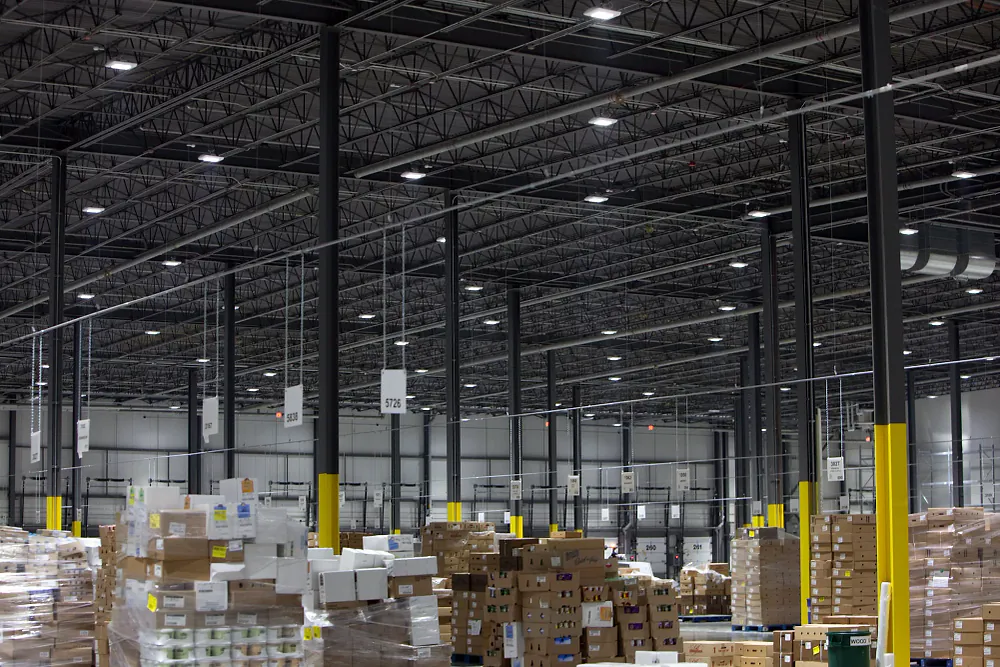
Five inputs decide a layout: maintained illuminance target, room geometry, mounting height above the working plane, photometric distribution, and maintenance factor. Rack obstruction and surface reflectances enter through the utilisation factor. The lumen method gives a first estimate before simulation: N = (E × A) ÷ (Φ × UF × MF), where E is maintained illuminance in lux, A is area in m², Φ is initial flux per luminaire in lumens, UF the utilisation factor and MF the maintenance factor.
Consider a 4,500 m² open storage area at 300 lx, using a 240 W luminaire of 36,000 lm with UF 0.65 and MF 0.80: N = (300 × 4,500) ÷ (36,000 × 0.65 × 0.80) ≈ 72 luminaires. A 9 m × 7 m grid in a 60 m × 75 m hall keeps the spacing-to-height ratio near 1.0 at 8 m, for a connected load of 17.3 kW. Treat that as a budget, not a design: design to roughly 10% above target, then run the layout in DIALux or AGi32 with the manufacturer photometric file.
5. Installation and Commissioning
Work at these heights requires an electrician working to local wiring rules, with luminaires suspended from structural members rather than from services. Three factors decide whether the installed result matches the calculation:
Mounting height and spacing. Set the height so the spacing-to-height ratio lands between roughly 0.8 and 1.5 for the chosen optic; exceed it and dark bands appear even when average lux looks correct.
Ingress and impact protection. Request the IP rating and the IK code separately. IP covers dust and water entry; IK covers mechanical impact energy to IEC 62262, tested by the hammer methods of IEC 60068-2-75. Neither value can be inferred from a mounting height, a case study or a product family, so obtain the classification for the exact variant ordered.
Electrical interface. Verify input voltage range, power factor and surge protection against the site supply, and confirm whether the driver is built in or remote.
Commissioning turns the design into evidence: record the as-built layout, measure horizontal illuminance on the working plane and vertical illuminance on rack faces with a calibrated meter, and log ambient temperature, because LED flux falls as the thermal path heats up.
6. Maintenance and Real Retrofit Numbers
LED luminaires degrade rather than fail like lamps. Output declines as the junction and driver age; the practical failure modes are driver electronics, thermal-cycling fatigue and dust on the lens. A 50,000 h rating is a projection to 70% of initial lumens under defined conditions, so ask for the L70 or L80 value, the TM-21 projection and the case temperature it assumes: at 4,000 operating hours per year that rating is about twelve years, and at 6,000 hours closer to eight.
A workable programme combines three actions: clean lenses and heat sinks at the interval implied by measured illuminance loss, replace failed drivers individually where the luminaire allows, and plan group replacement once cleaning no longer restores output. Log driver failures by position, because repeat failures point to a thermal or supply problem rather than a batch defect.
A documented CPS retrofit replaced 132 ordinary 200 W LED luminaires with 102 units of a 150 W high bay in a 2,350 m², 12 m hall of 13 badminton courts, cutting connected load from 26.4 kW to 15.3 kW, with savings recorded above 40%. That arithmetic follows from the published counts; the case publishes no IP, IK or beam-angle values, so none should be attributed to it.
7. Controls, Costing, and What to Ask a Supplier
Once efficacy is fixed, controls decide the energy result. Aisles stand empty for long periods, so occupancy-based zone switching, dimming outside working hours and daylight-linked dimming near loading doors cut consumption without reducing illuminance in occupied zones. Confirm whether the driver accepts 0–10 V, DALI or another protocol, and compare options on watts, operating hours and maintenance visits rather than purchase price.
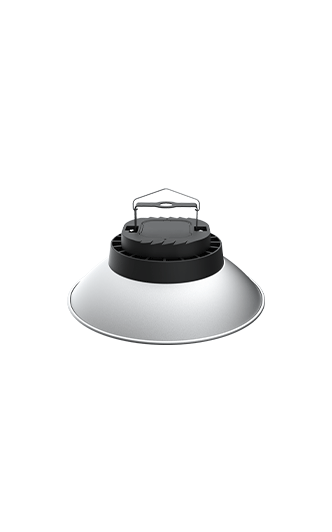
Current CPS high bays include the Uranus S 100–200 W high bay at 140 lm/W with 80° and 70° lenses, Ra > 80 and 3000K to 6500K options, and the external-driver Uranus high bay at 150 lm/W. Both publish CE-EMC, CE-LVD and RoHS documentation rather than a DLC listing, so buyers needing rebate-eligible models should confirm listing status and the datasheet for the exact wattage.
Definition and layout background sits in high bay versus low bay lighting and warehouse LED high bay lights; the counting method is worked through in how many LED high bay lights are needed, and a measured retrofit in the Grade III badminton hall lighting retrofit.
8. Technical Sources
1. EN 12464-1, Light and lighting, Lighting of indoor work places: storage, logistics and industrial task illuminance values.
2. IEC 62262, Degrees of protection provided by enclosures against external mechanical impacts, with the hammer testing of IEC 60068-2-75.
3. IES LM-79 and IES LM-80, measurement of solid-state lighting products and lumen maintenance testing.
4. CPS Lighting Uranus S-GK-TWX-S LED high bay light product data.
Core Keywords:
high bay light fixtures, LED high bay, industrial high bay lighting, high bay mounting height, EN 12464-1 warehouse illuminance, IK rating for LED lights, lumen method calculation, DIALux lighting simulation