Contents
1. LED Dimming Starts With Compatibility
2. What the Control Signal Changes
3. Choosing a Dimming Control Method
4. Driver, Dimmer and Fixture Checks
5. Flicker, Low-End Performance and Commissioning
1. LED Dimming Starts With Compatibility
LED dimming is often sold as a simple energy-saving feature. For a wholesale buyer, it is better treated as a system decision. The fixture, LED driver, control device, wiring topology and required operating range all need to agree. A dimmable lamp connected to an unsuitable dimmer may switch on, yet still flicker, buzz or refuse to reach a stable low output.
This matters in retail, offices, hospitality and industrial projects because lighting is rarely used at one fixed level. The right LED dimming technology can support task settings, daylight response and after-hours scenes. It does not guarantee a particular energy reduction by itself; the result depends on operating hours, the dimming schedule and the minimum permitted output.

2. What the Control Signal Changes
An LED driver converts incoming power into controlled current for the LED board. Dimming changes either the current level or the way that current is delivered. Pulse-width modulation (PWM) alternates the LEDs between on and off at a set frequency; the duty cycle determines perceived output. Constant-current reduction lowers the drive current while the LEDs remain energised. Both methods can work well, but their low-end behaviour and camera performance must be verified with the supplied driver.
Flicker is therefore not a fixture-only issue. It can be affected by the driver design, the input dimmer, mains conditions and the selected dimming level. For video-sensitive applications, specify the required camera use early and compare the manufacturer’s published flicker information with the intended control method. CPS Lighting’s low-flicker lighting guide explains why control and driver selection should be checked together.
3. Choosing a Dimming Control Method
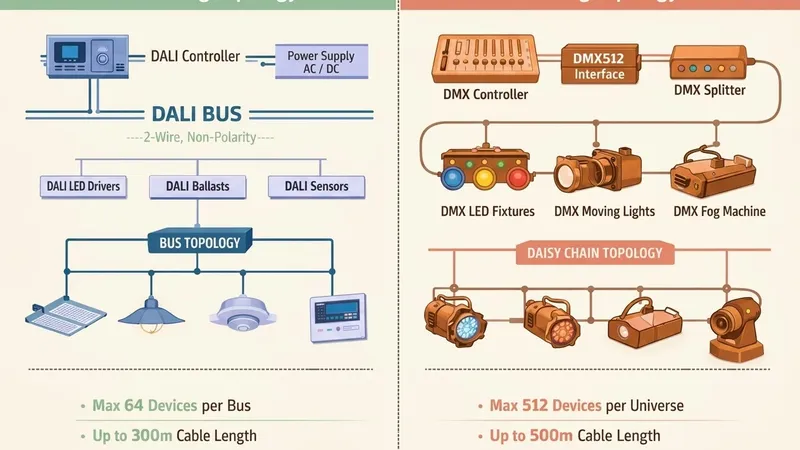
Phase-cut, 0-10 V and DALI-2 solve different problems. Phase-cut control can suit smaller retrofit jobs where compatible mains dimmers already exist. 0-10 V is a familiar analogue option for zoning, but it usually needs dedicated low-voltage control conductors. DALI-2 is a digital, addressable protocol based on IEC 62386; it supports configuration, status queries and individual or group control when the project needs more detailed commissioning.
| Method | Best fit | Buyer check |
|---|---|---|
| Phase-cut | Small retrofits and simple local control | Confirm the exact leading-edge or trailing-edge dimmer compatibility. |
| 0-10 V | Zoned commercial lighting | Check control-wire routing, polarity requirements and minimum dim level. |
| DALI-2 | Addressable scenes, monitoring and scalable control | Verify bus design, device compatibility and commissioning scope. |
The digital option is not automatically the right choice. Its addressing and commissioning capability can justify the added planning effort in a multi-zone site. A single-room renovation may instead benefit from a simpler compatible control arrangement. CPS Lighting’s overview of DALI-2 control systems offers a useful contrast between digital control approaches.
4. Driver, Dimmer and Fixture Checks
Before ordering, request a clear control compatibility statement for the exact driver and fixture configuration. Product families can have multiple driver versions, so a general “dimmable” label is not enough. The checks below prevent many avoidable returns and site adjustments.
Required control method, including the exact dimmer or controller model where phase-cut is used.
Published dimming range and the lowest stable output needed for the application.
Driver input voltage, load limits, control wiring and any required auxiliary power.
Expected operating environment, especially heat, long cable runs and generator-powered sites.
For a broader hardware review, compare the driver information supplied with relevant fixtures in the CPS Lighting product range. If an installed system already shows unstable output, start with the control path and driver diagnostics described in this LED driver troubleshooting guide.
5. Flicker, Low-End Performance and Commissioning
A commissioning test should be more demanding than a switch-on check. Run every proposed scene, move gradually from full output to the intended minimum level, and observe whether fixtures track together. In a large zone, inconsistent response can indicate mixed driver revisions, an incorrect dimming curve or control-wiring faults. Record the final scene levels, controller addresses and any locked minimum values for maintenance teams.
Picture a restaurant that dims dining areas while keeping the service path brighter. The design question is not only whether the lamps dim; it is whether colour appearance, visual comfort and wayfinding remain acceptable at the selected levels. This is also where a sample installation is useful. Test a representative fixture, driver and control device before placing a large commercial LED lighting order.

6. Applying Controls to a Project
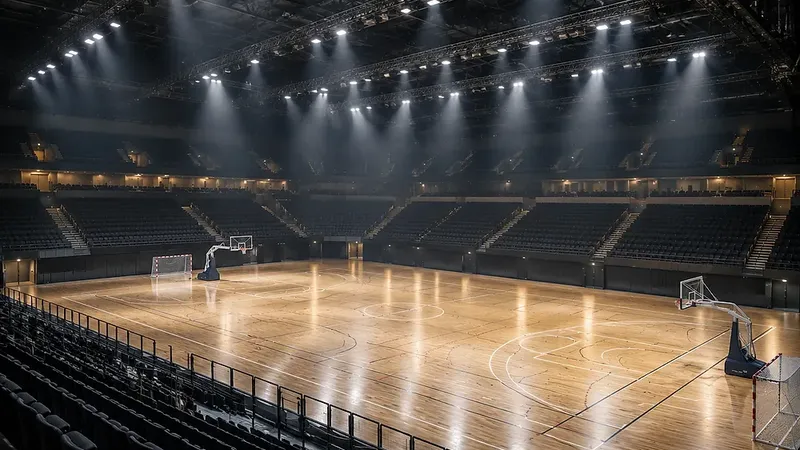
Controls create value when they are designed around real operating modes. In its multi-purpose arena lighting reference, CPS Lighting describes an Ocean University gymnasium rebuild with eight commissioned scene modes and zonal dimming. Those are project-specific settings, not a universal outcome, but they show why a scene schedule should be agreed before handover.
For buyers, a workable procurement brief should name the operating scenes, control protocol, fixture quantity by zone, target minimum output and acceptance test. This turns a generic request for dimmable LED lighting into a specification that a supplier, installer and controls contractor can check together.
7. Technical Sources
DALI Alliance: DALI Quick Start Guide, covering the IEC 62386-based DALI protocol and DALI-2 certification framework.
IEEE: IEEE 1789-2015, recommended practices for modulating current in high-brightness LEDs and mitigating viewer health risks.
Core Keywords:
LED dimming technology, dimmable LED lighting, LED dimmer compatibility, DALI-2 control, 0-10 V dimming, PWM dimming, LED driver, commercial LED lighting wholesale