Contents
1. Start with the Lighting Task
2. Compare Lumens, Lux and Power
4. Choose Color Quality and Compatible Controls
5. Check Outdoor Protection and Reliability
6. Adjust the Specification to the Application
1. Start with the Lighting Task
LED flood lights should be chosen by the light needed on a surface, not wattage alone. Start with the area, mounting height, operating hours and nearby windows. A loading yard, building façade and outdoor event can require different optics and controls, even when their floor areas are similar.
LED stands for light-emitting diode. A floodlight combines these light sources with optics, a driver and a housing. It does not necessarily produce a wide beam: the Illuminating Engineering Society describes floodlights with narrow through wide distributions. Define the task first, then compare the complete luminaire rather than isolated LED-chip specifications.

2. Compare Lumens, Lux and Power
Lumens measure emitted light; illuminance, measured in lux, describes light arriving on a surface. The same lumen output can produce different results when aiming, distance or beam distribution changes. Ask for a layout calculation showing average and minimum illuminance, not a universal lumen recommendation for every car park or doorway.
Compare luminaire efficacy in lumens per watt (lm/W), using total fixture output and input power. The examples below assume 4,000 operating hours per year. They are calculations, not product specifications or measured savings.
| Design example | Input power | Light output | Efficacy | Annual energy |
|---|---|---|---|---|
| A | 150 W | 18,000 lm | 120 lm/W | 600 kWh |
| B | 150 W | 22,500 lm | 150 lm/W | 600 kWh |
| C | 120 W | 18,000 lm | 150 lm/W | 480 kWh |
On smaller screens, swipe within the table to view every column.
Annual energy equals watts × operating hours ÷ 1,000. Design C uses 20% less energy than A at the same rated lumen output. Equal lumens still do not prove equal useful illumination; the optics must also suit the site.
3. Match the Beam to the Site
A narrower distribution concentrates light over a smaller angular range, which can help with longer throws. A wider distribution can cover nearby areas, but may send more light beyond the boundary. Neither is automatically better: mounting height, setback and aiming determine whether the light reaches the target or produces glare.
Check how the supplier defines beam angle. In IES terminology, beam angle uses the 50% peak-intensity boundary, while field angle uses 10%. These are not interchangeable measurements. Review the photometric file and aiming plan, including spill toward homes and drivers, rather than selecting a nominal angle alone.
4. Choose Color Quality and Compatible Controls
Correlated color temperature (CCT) describes whether white light looks warmer or cooler; it does not measure brightness. Options such as 3000 K, 4000 K and 5000 K should be compared against the task and local requirements. Color temperature and color rendering index (CRI), which describes color fidelity, are separate specifications.
Choose controls around operating hours and occupancy. LED dimming requires a compatible driver and control interface; not every floodlight accepts the same dimmer. Confirm the dimming range, sensor behavior and restart settings. For outdoor events with cameras, also verify flicker performance at the intended settings.
5. Check Outdoor Protection and Reliability
An IP rating classifies enclosure protection against ingress under IEC 60529. It is not a complete outdoor durability guarantee. Match documented protection to dust, rain and cleaning exposure, then separately check corrosion resistance, ambient-temperature limits, surge protection and cable entries. The installed arrangement must follow the manufacturer’s instructions.
LEDs still produce heat, and the driver is a separate potential failure point. A claimed 50,000-hour life needs its test conditions and light-output criterion; it does not mean every component is guaranteed to operate that long. Compare warranty coverage, replacement-driver availability and maintenance access instead of assuming an LED floodlight is maintenance-free.
6. Adjust the Specification to the Application
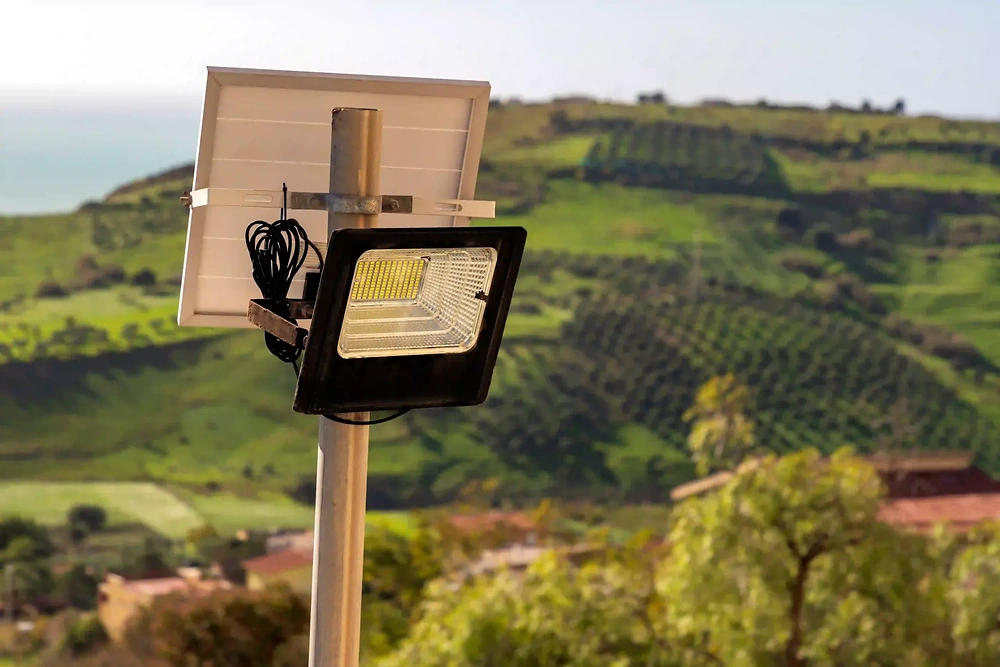
For commercial yards, check routes, obstacles and boundary spill. For façades, compare beam coverage on the vertical surface. Public roads and sports venues need their applicable lighting criteria; a general floodlight description is not proof of suitability. Solar floodlights add a separate energy question: the panel, battery and operating schedule must suit local sunlight.
Record mounting positions, supply voltage and hours of use.
Identify required illuminance, uniformity and glare constraints.
Confirm control requirements before requesting comparable quotations.
7. Verify the Supplier, Installation and Maintenance Plan
Ask suppliers for the exact model, optic, driver specification, photometric file and relevant test documentation. A lighting model can compare fixture quantities and aiming before purchase. Qualified installers should verify mounting strength, electrical protection and safe access; this guide is not a substitute for wiring instructions or local electrical requirements.
After installation, measure the agreed grid and check aiming and controls. Keep the settings and results for future comparison. Inspect lenses, fixings and seals according to site conditions. Persistent flicker or failure needs fault diagnosis, not an automatic driver replacement. Compare whole-life service needs alongside the initial price.
8. Technical Sources
1. IES: floodlight definition — Distribution may be narrow or wide.
2. IES: beam angle — The 50% peak-intensity definition.
3. IES: field angle — The 10% peak-intensity definition.
4. U.S. Department of Energy: LED Basics — Luminaire performance, color quality and reliability considerations.
5. IEC 60529: enclosure protection — The IP classification standard, not a complete outdoor specification.
Core Keywords:
LED flood lights, outdoor LED flood lights, floodlight beam angle, lumens and lux, LED floodlight efficiency, IP rating, LED floodlight selection