Contents
1. Understand How Solar Outdoor Lighting Works
2. Choose the Application Before the Fixture
3. Match Daily Generation to the Lighting Schedule
4. Compare Panels, Batteries and Current Products
5. Site and Install for the Design Season
6. Use Controls Without Losing Useful Light
1. Understand How Solar Outdoor Lighting Works
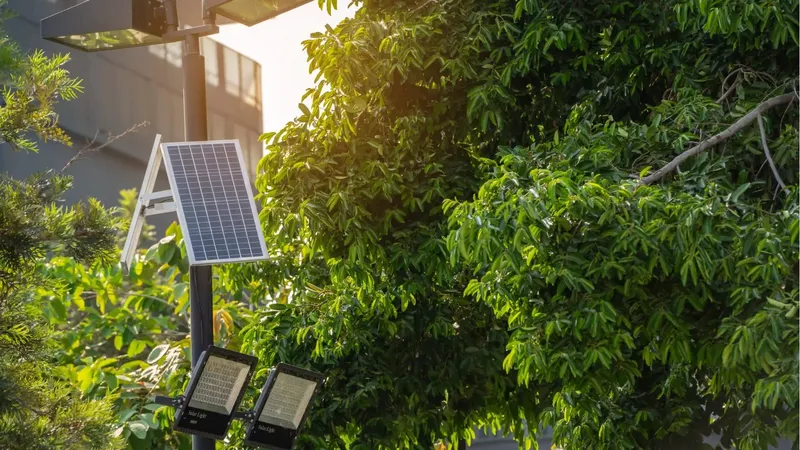
Solar outdoor lighting combines a photovoltaic panel, charge controller, battery and LED luminaire. The panel converts light into direct-current electricity. The controller manages charging and protects storage within its configured limits. At night, the battery supplies the luminaire according to a timer, light sensor or programmed control schedule.
The cycle depends on the balance between daytime generation and night-time demand. Solar lighting can avoid grid electricity at the point of use, but equipment production, installation and battery replacement still have environmental impacts. Neither an aluminium housing nor a high LED efficacy proves that a complete system can deliver the required lighting throughout winter.

2. Choose the Application Before the Fixture
Garden markers, pedestrian paths, village roads and commercial areas have different lighting duties. Decorative products should not be assumed suitable for vehicle routes or security tasks. Define the area, operating hours, required illumination, uniformity and acceptable spill before choosing a luminous-flux rating. Lumens describe light emitted; lux describes light reaching a surface.
Indoor off-grid lighting also needs an outdoor panel or another adequately exposed energy source. A roof-mounted photovoltaic array does not automatically include battery storage, and an indoor lamp cannot simply charge itself from ordinary room light. For shaded sites, assess the difference between direct and diffuse sunlight and the available seasonal energy.
3. Match Daily Generation to the Lighting Schedule
Compare battery energy in watt-hours (Wh), not milliamp-hours alone. Nominal energy equals voltage multiplied by amp-hours. An illustrative 12.8 V, 20 Ah battery stores 256 Wh. An assumed 80% usable fraction gives 204.8 Wh before subsequent delivery losses and auxiliary demand. This fraction is an example, not a battery discharge recommendation.
A hypothetical 20 W luminaire operating for 10 hours needs 200 Wh. For an initial generation estimate, multiply panel watts by peak sun hours and an assumed delivery factor. Peak sun hours represent equivalent full-strength irradiation, not the number of hours between sunrise and sunset. The table assumes 3 peak sun hours and a 0.70 delivery factor.
| Illustrative panel rating | Calculated daily energy | Balance against 200 Wh demand |
|---|---|---|
| 80 W | 168 Wh | 32 Wh shortfall |
| 120 W | 252 Wh | 52 Wh surplus |
| 160 W | 336 Wh | 136 Wh surplus |
On smaller screens, swipe within the table to view all columns.
These figures are arithmetic scenarios, not CPS product results or autonomy guarantees. Cloud sequences, temperature, shading and charging limits change the outcome. A larger battery can delay depletion but cannot indefinitely solve a persistent energy deficit. Check night-time runtime against the actual programmed output, rather than an unspecified “all-night” claim.
4. Compare Panels, Batteries and Current Products
Select panel technology by verified output, available mounting area and local conditions rather than a simple premium-versus-budget label. Ask for battery chemistry, nominal voltage, usable capacity, charging-temperature limits and replacement availability. LiFePO4 is a lithium-ion chemistry; it is not a separate alternative to all lithium-ion batteries. A cycle-life claim needs its test conditions.
Current Hulk-E-3rd solar street lights list 5,000–18,000 lm options and programmable periods. The Sunflower solar range lists 1,000–4,000 lm options, LiFePO4 storage and microwave sensing. Confirm the quoted configuration’s panel, battery and photometric file. Those ranges cannot establish pole spacing or winter autonomy.

5. Site and Install for the Design Season
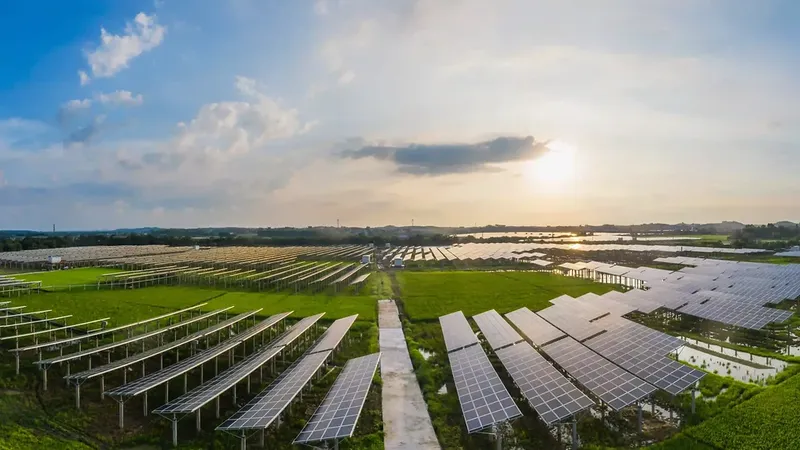
Survey shading from trees, buildings and future vegetation. Panel tilt and direction depend on latitude, hemisphere, seasonal demand and mounting constraints. “Always face south” is not worldwide guidance. A split-panel system can separate useful solar exposure from the best luminaire aiming position, but adds brackets, cabling and maintenance points.
Verify structural loading, protected connections, service access and the complete installation instructions. Check the exact enclosure rating rather than prescribing IP67 for every outdoor application. IP ratings address ingress under specified conditions; they do not alone establish corrosion resistance, impact strength or suitability for every washdown regime. Grid-backup models require their specified electrical installation.
6. Use Controls Without Losing Useful Light
Dimming and occupancy sensing can reduce battery demand, provided the reduced output remains suitable for the task. Confirm detection coverage, transition timing and behaviour after prolonged low charge. Remote management requires compatible hardware and communications; it is not a standard feature of every solar light.
CPS Lighting’s Hangzhou Asian Games smart-pole project describes remote dimming and unified device management. It demonstrates control integration, not off-grid charging or battery autonomy. Use project evidence for the specific capability it establishes, and request separate energy evidence for a solar proposal.
7. Maintain and Verify the Complete System
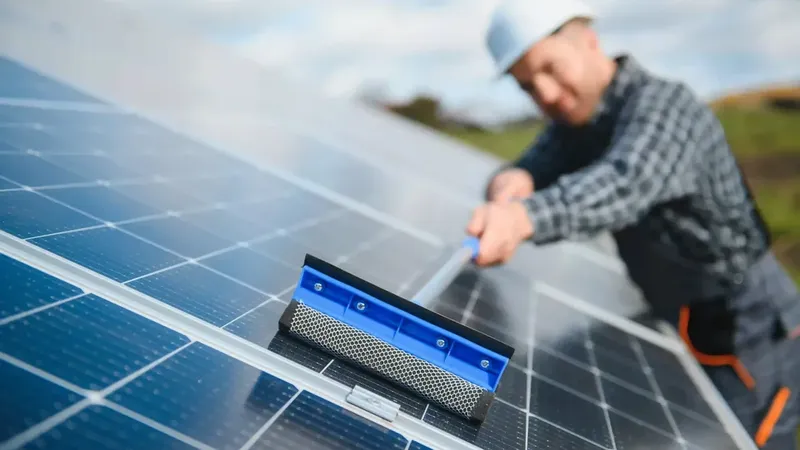
Keep panels free of dirt and new shading using a suitable solar-panel cleaning method. Inspect fixings, seals and connections at intervals suited to the environment. Battery replacement timing depends on chemistry, temperature and cycling; a universal two-to-three-year replacement promise is not justified.
At commissioning, record panel orientation, controller settings, charge status and measured illumination. Compare operation across representative conditions, not just after one sunny day. If output falls early, investigate shading, reduced charge, settings and battery condition before replacing components. Assess purchase price together with installation, replacement batteries and maintenance visits to compare lifetime cost.
8. Technical Sources
The energy table uses explicit design assumptions. Product and project information is linked in the relevant sections; verify the final configuration before ordering.
1. U.S. Department of Energy: photovoltaic system design basics
Core Keywords:
solar outdoor lighting, solar lighting systems, solar street lights, solar battery sizing, solar lighting energy budget, off-grid lighting