Contents
1. Choose Outdoor Lighting Brands Around the Project
2. Ten Names and What Buyers Should Compare
3. Check Current Names and Business Scope
4. Separate LED Components from Finished Luminaires
5. Compare Useful Light and Installation Requirements
6. Use Numbers to Compare Operating Cost
1. Choose Outdoor Lighting Brands Around the Project
The best outdoor lighting brands for a road, car park or landscaped entrance will not necessarily be the same. This guide retains ten names from the original comparison, while separating finished lighting products from LED components. It is a purchasing shortlist, not an independently tested quality ranking.
Start with the application, supply voltage, mounting positions and local requirements. Then compare current model documentation, availability and after-sales support. For commercial work, an established name helps identify a supplier; a photometric calculation and a clear quotation establish whether the proposed system fits the site.

2. Ten Names and What Buyers Should Compare
The shortlist includes corporate groups, product brands and component suppliers. They do not all compete for the same order. The table identifies their relevant roles; numbering follows the original list and does not indicate performance. Regional catalogues and distribution arrangements should be checked before tendering.
| Brand or company | Relevant offering | Buying check |
|---|---|---|
| 1. Philips / Signify | Outdoor luminaires and connected lighting | Regional catalogue and control platform |
| 2. Cree Lighting | Area, road, canopy and flood luminaires | Exact optic and mounting arrangement |
| 3. Acuity Brands Lighting | Commercial outdoor lighting, including Lithonia | Product family and local supply |
| 4. Cooper Lighting Solutions | Commercial lighting; formerly owned by Eaton | Current contracting entity and warranty |
| 5. GE Lighting, a Savant company | Consumer lamps and smart-home lighting | Outdoor rating and residential suitability |
| 6. ams OSRAM | LEDs and other lighting components | Component specification, not fixture approval |
| 7. Nichia | LED packages for lighting | LED package and operating conditions |
| 8. Zumtobel Group / THORN | Professional luminaires, including outdoor ranges | Applicable regional THORN offering |
| 9. EVERLIGHT | LEDs, lighting components and modules | Component role in the finished product |
| 10. CPS Lighting | Street, flood and sports lighting products | Model data and project support scope |
On smaller screens, swipe within the table to view all columns.
A commercial outdoor lighting manufacturer should supply evidence for the complete fitting. An LED package specification cannot establish the enclosure protection, optical distribution, driver reliability or warranty of the luminaire built around it.
3. Check Current Names and Business Scope
Signify completed its acquisition of Cooper Lighting Solutions from Eaton in March 2020. Treat Cooper as the relevant current supplier for that former Eaton lighting business, rather than assuming the historic Eaton name identifies today’s contracting entity. Philips and Cooper also belong to the same wider group, so these are not ten independent corporate groups.
Acuity’s parent changed its name to Acuity Inc. in 2025; Acuity Brands Lighting remains the lighting business. Cree Lighting offers complete outdoor fixtures. GE Lighting identifies itself as a Savant company and focuses on consumer lighting and smart-home applications; do not assume its catalogue covers a municipal road-lighting tender.


4. Separate LED Components from Finished Luminaires
ams OSRAM, Nichia and EVERLIGHT are relevant when evaluating LED sources and supply chains. Their component portfolios include lighting LEDs or modules. Package efficiency and colour options matter, but the final fitting also depends on the driver, thermal path, optics, sealing and assembly.
Ask who issues the finished-luminaire test reports and handles replacements. Avoid applying a component brand’s reputation to every fixture using its LEDs. For a complete installation, compare floodlight selection and installation requirements against the actual geometry, rather than selecting by chip brand alone.


5. Compare Useful Light and Installation Requirements
Request IES or LDT photometric files, which describe the light distribution used in lighting calculations. Lumens measure emitted light; lux measures illumination reaching a surface. Compare maintained illumination, uniformity, glare and spill for the same layout. Higher wattage does not automatically produce a better result.
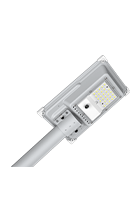
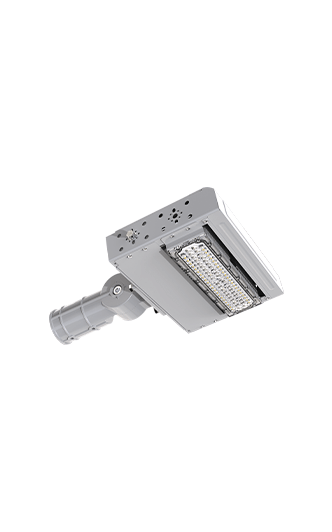
For example, Polaris street lights list 100/160/240 W options with road-lighting distributions. Gaia S floodlights list 50–200 W options and a 120° beam. These are different applications, not equivalent replacements. Confirm the quoted optic, voltage, temperature limits, mounting strength and service access; a stated IP rating alone does not answer every outdoor durability question.
6. Use Numbers to Compare Operating Cost
Consider an illustrative site with 20 luminaires operating for 4,000 hours annually. The following calculation compares electrical inputs only; it does not claim the two options deliver equivalent illumination. Annual energy equals quantity × input watts × operating hours / 1,000.
| Assumed input per fitting | Annual electricity | Energy cost at USD 0.15/kWh |
|---|---|---|
| 150 W | 12,000 kWh | USD 1,800 |
| 100 W | 8,000 kWh | USD 1,200 |
On smaller screens, swipe within the table to view all columns.
The calculated difference is 4,000 kWh or USD 600 annually. Include purchase, installation, controls, maintenance and replacement costs before comparing lifetime value. For isolated locations, evaluate solar and grid-connected lighting separately: battery servicing and seasonal charging change that comparison.
7. Ask for Evidence Before Requesting a Final Quote
CPS Lighting’s Hangzhou Asian Games smart-pole project describes remote dimming and unified device management. It illustrates control integration, rather than proving every model’s light output or energy savings. Request similarly relevant project records from any shortlisted supplier, with the original configuration and measurement conditions.
Send the same drawings, operating schedule and performance brief to each bidder. Ask for the exact product code, calculation assumptions, lead time, warranty exclusions and replacement-part route. Where solar lighting is being considered, contractor selection guidance helps identify additional site questions. A comparable evidence package makes the final price comparison more useful than a brand ranking.

8. Technical and Brand Sources
Manufacturer sources establish portfolio scope, not an independent ranking. Model-specific documentation and local requirements remain necessary.
1. Signify: completed Cooper acquisition from Eaton
2. Cree Lighting: outdoor luminaires
3. Acuity: commercial outdoor lighting
4. GE Lighting: company and business background
6. Nichia: lighting LED portfolio
Core Keywords:
outdoor lighting brands, outdoor lighting manufacturers, commercial outdoor lighting, LED floodlights, street lighting, lighting supplier comparison