CAMPUS FOOTBALL AND ATHLETICS LIGHTING
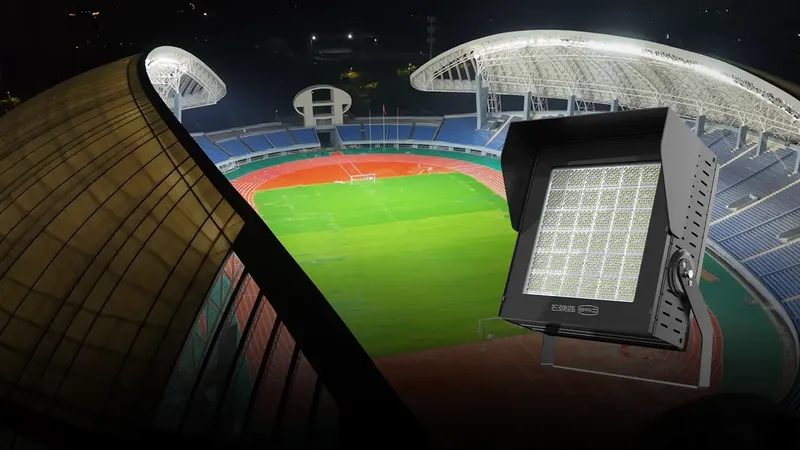
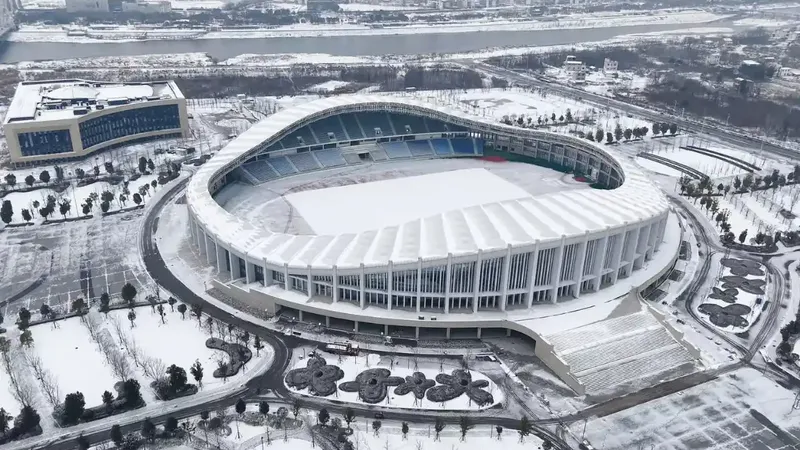
CPS Lighting designs and supplies sports lighting systems. At the Leifeng Campus of Hunan University of Finance and Economics in Changsha, China, CPS provided the lighting solution for an 11-a-side football pitch and 400 m athletics track. Six shared masts carry separate lighting groups for the playing area, track and an entrance-facing allocation.
The installed configuration comprises 38 × 1000 W TLX series lights and 12 × 300 W TL01 series lights. Combined rated power is 41.6 kW, calculated. The project account reports at least 500 lx average on the pitch and 33 lx on the track; these are reported project results, not independently verified measurements.
Share your site plan and mounting details. The simulation depends on those inputs; the installed result requires site verification.

6 masts
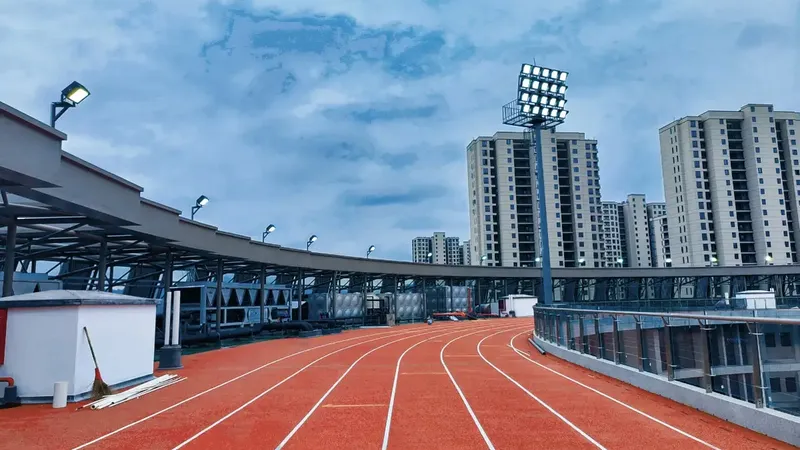
20 m high; two-sided layout
50 luminaires
38 TLX units + 12 TL01 units
≥500 lx
Reported pitch average illuminance
1. One campus venue, two lighting tasks
The campus required lighting for evening football, training and recreational running. This was a lighting construction project for the new sports venue; the available record does not establish a previous lighting system or a retrofit energy baseline.
The pitch needed cross-field coverage and controlled glare. The surrounding track needed its own light distribution around straights and bends. Sharing mast structures brings the two systems together physically, while their mounting heights and aiming serve different areas.
| Installed group | Quantity and rated power | Mounting arrangement |
|---|---|---|
| TLX series: pitch / entrance allocation | 38 × 1000 W; 38.0 kW calculated | Six 20 m masts, arranged on two sides |
| TL01 series: athletics track | 12 × 300 W; 3.6 kW calculated | Mounted at 8 m on the same six masts |
On narrow screens, swipe the configuration table horizontally.
2. Aim the pitch, track and entrance separately
The original Chinese project account records eight TLX luminaires on the mast nearest the campus gate, with two aimed toward the entrance. It does not say all eight illuminate the gate. This allocation matters when reviewing how much light is assigned to the pitch rather than adjacent areas.
The 20 m main mounting height supports longer throws across the pitch; the 8 m track mounting level serves a different geometry. For a similar venue, the optical model should include the full running loop, goal areas, neighbouring buildings and entrance routes. Check overlap, bright spots, player sightlines and spill together. More average light does not automatically mean better uniformity or lower glare.


3. Read the reported results against the brief
The case’s performance table and Chinese account report the following values. The requirement column reproduces the project brief; it is not a universal standard table for every football venue.
| Metric | Project requirement | Reported result |
|---|---|---|
| Pitch average illuminance | ≥300 lx | ≥500 lx |
| Pitch uniformity, labelled U2 | ≥0.5 | ≥0.6 |
| Pitch glare rating (GR) | <50 | <50 |
| Track average illuminance | ≥30 lx | 33 lx |
On narrow screens, swipe the results table horizontally.
The original test grid, instrument record and glare assessment are not supplied. The available material does not define the U2 ratio, so its label is retained without assigning a different uniformity formula. These results support the documented brief without establishing broadcast certification or complete compliance with another competition category.
38 × 1000 W + 12 × 300 W = 41.6 kW combined rated power. This is not metered site demand. No defensible saving percentage, annual electricity cost or payback can be calculated without a baseline, actual switching schedule, operating hours and tariff.
4. CPS design, supply and quality support
The project record supports CPS’s lighting solution, two-sided layout and TLX/TL01 supply configuration. It does not separately document who performed electrical installation or the scope of on-site commissioning. For a new campus project, those responsibilities should be agreed with the supply and design scope.
CPS’s manufacturing capabilities include metal processing, finishing and assembly. Its laboratory equipment covers optical, electrical and environmental testing. These capabilities support product evaluation; an equipment list does not certify every historical model or installation.
5. Installed series and a current selection reference
Installed project configuration: 38 TLX series 1000 W lights and 12 TL01 series 300 W lights. The original order codes, lenses, drivers and colour-temperature selections remain unconfirmed.

Dubhe Projection Light — 1000 W
Current main-pitch selection reference only; it is not confirmed as the installed TLX series. Track-light selection requires a separate review.
| Catalogue item | Published reference |
|---|---|
| Rated power | 1000 W |
| Luminous flux | 150,000 lm |
| Colour rendering index | Ra ≥ 80 |
| Ingress protection | IP66 |
Catalogue values describe the current reference product, not the campus installation. Final selection requires the mounting geometry, photometric files and required pitch and track performance; matching wattage alone does not establish an equivalent replacement.
6. Plan your football and track lighting
Send CPS a site plan or computer-aided design (CAD) drawing, pitch and track dimensions, mast locations and heights, intended uses, photographs and project location. Identify nearby buildings and entrance routes, plus operating modes and any required assessment criteria. For a retrofit, add existing fixture details, measured consumption and running hours.
Share your site plan and mounting details. The simulation depends on those inputs; the installed result requires site verification.