Badminton Lighting Retrofit with Lower Rated Power
CPS Lighting designs and supplies indoor badminton court lighting. At Sitong Sports and Culture Art Center in Zunyi, Guizhou, the retrofit addressed an uneven lighting layout, glare and inadequate brightness across a 13-court hall.
The project replaced 132 reported 200W fixtures with 102 professional 150W units. For your own venue, CPS offers free DIALux lighting simulation to review court coverage and fixture positions before equipment selection.

13
Badminton courts
Venue scale reported in the CPS case.
12 m
Hall height
Not an assumed luminaire mounting height.
≈42%
Lower rated fixture power
Calculated from the stated quantities and wattages.
1. A lighting brief built around badminton
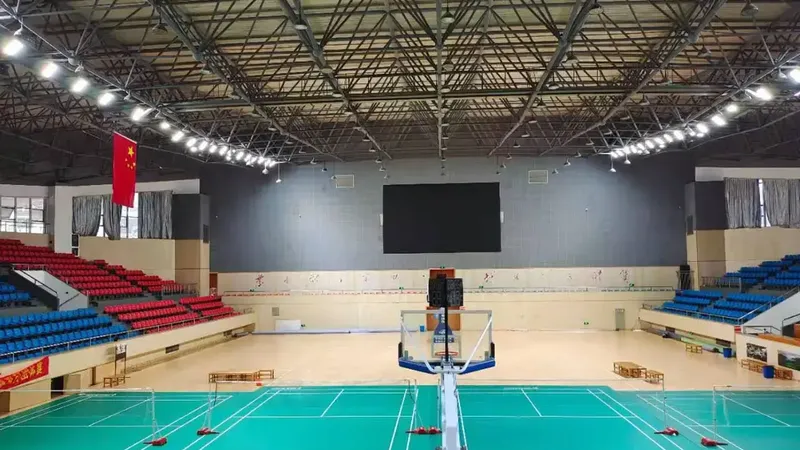
The hall is in Huichuan District, Zunyi. CPS’s current project record lists approximately 2,350 m², while the original narrative identifies 13 courts and a 12 m ceiling height. The brief was to support badminton competition, training and public play within the existing building.
Badminton players frequently look upward to follow a white shuttlecock. A bright lamp in that viewing direction can interfere with tracking even when the floor looks well lit. The retrofit therefore involved light distribution and fixture positions, not simply increasing wattage.
The source describes a replacement luminaire with a matte-silver reflector and tailored distribution. Its purpose was to direct useful light across the courts while reducing stray light and direct glare. The supplied photographs show the blue playing surfaces and surrounding walls, but they do not establish measured glare or flicker performance by themselves.

2. Brightness and rated power: before and after
The original CPS summary reports average court illuminance increasing from below 500 lx to above 750 lx. The fixture quantities and ratings also allow a transparent connected-power comparison. These are case-reported lighting values and calculated rated-power figures, not independently audited meter readings.
| Metric | Original system | Retrofit system |
|---|---|---|
| Fixture quantity | 132 | 102 |
| Rated power per fixture | 200W | 150W |
| Total rated fixture power (calculated) | 26.4 kW | 15.3 kW |
| Average court illuminance (CPS summary) | <500 lx | >750 lx |
Illuminance source: original CPS before-and-after summary. Fixture quantities and wattages come from the supplied project narrative.
The rated fixture total falls by 11.1 kW, or approximately 42%. This supports the original account of more than 40% savings at the rated-load comparison level. Actual electricity use also depends on operating hours, dimming, controls and measured input power; the percentage is not a guaranteed reduction in the venue’s total bill.
CPS describes a Grade III competition brief under JGJ 153-2016. Average illuminance alone does not prove complete compliance: the approved measurement grid, uniformity and glare assessment are also needed. This classification should not be confused with BWF tournament approval or a television-broadcast specification.
3. The replacement scheme and product options
The historical narrative calls the replacement fixture a 150W HY-series professional court light; the current case overview lists a 150W Uranus S high bay. The clear common information is the 150W rating and 102-unit replacement scheme. Confirm the full historical model against the project supply record if that detail is needed.
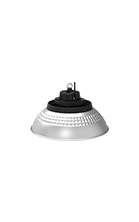
For a new enquiry, the current Uranus S catalogue provides external-power-supply and built-in-driver versions, with listed 100W, 150W and 200W options. These are current product references, not proof that either photographed configuration was installed in the original project.


Current catalogue images, displayed at comparable sizes rather than physical scale.
A reflector high bay is not automatically suitable for every badminton hall. Ask CPS to evaluate the proposed optics and driver for your court grid, mounting conditions, player sightlines and any camera requirements.
4. Layout, installation and handover
CPS’s source account covers optical calculations, revised layout, fixture supply and installation/commissioning. For a new retrofit, survey the existing beam positions and circuits before deciding whether brackets or wiring can be reused.
During handover, compare illuminance readings with the agreed grid, inspect visibility from both ends of each court and record the final fixture positions. If match recording is required, test the intended camera settings rather than treat “no visible flicker” as a high-speed video guarantee. Keep the model and maintenance information with the venue records.
5. Evidence behind the lighting supplier
A buyer needs more than a photograph of a bright hall. CPS’s manufacturing and company profile identifies a business established in 2005 with a Huizhou production base. Its lighting testing laboratory lists electrical, photometric and reliability equipment for evaluating luminaires.
For customization, review the OEM/ODM capabilities and agree the selected optics, driver, mounting arrangement, warranty and documentation. Overseas installation support and local contractor responsibilities should be defined in the quotation.
The original Sitong badminton lighting case video is retained as an additional project reference. The renovation evidence should remain tied to this venue rather than presented as a universal outcome for replacing 200W lights with 150W lights.
6. Start with your badminton hall layout
Planning an LED badminton court lighting retrofit? Send CPS a court layout, hall dimensions, ceiling and fixture mounting heights, photographs of the existing lights and the intended level of play.
Request a free DIALux lighting simulation to discuss coverage and suitable fixtures. Include current lamp quantities, operating hours and any recording requirements so the proposal can address both visibility and running cost.
Email: info-cps@cps-lighting.com