CPS Lighting supplies solar LED street lights and supports rural road-lighting projects. In Nantaihu New District, Huzhou, Zhejiang, China, CPS assisted the installation of around 200 CPSL03 Haoxing series solar street lights across three villages, bringing lighting to village main routes used after dark.
The installation combined solar power with motion sensing, light sensing and time control. Its road-specific optics addressed light distribution along the route, while automatic controls managed output according to operating conditions. The project formed part of a wider programme to improve village living environments.

Solar street lights reported installed
Within Huzhou Nantaihu New District
Historical Haoxing series
1. Solar lighting for village main routes
The published scope covers three villages in Nantaihu New District. The photographs show roads beside homes, planted verges and stretches between buildings. These are local circulation routes where lighting needs to follow the road while taking account of nearby residents and vegetation.
| Project item | Published configuration |
|---|---|
| Location | Nantaihu New District, Huzhou, Zhejiang, China |
| Coverage | Three villages; approximately 200 solar street lights |
| Historical product | CPSL03 Haoxing series |
| Controls described | Motion sensing, light sensing and time control |
| Optical approach | Wide batwing distribution designed for roads |
Solar power was central to the scheme. The original account describes avoiding the supply-cable trenching associated with a new grid-fed installation. Pole foundations, secure mounting and access for maintenance still require site planning; avoiding a grid connection does not remove the need for civil works.


2. Road optics and automatic output control
The selected lights used a wide batwing optical distribution: light is directed outward to cover the road rather than concentrated only below the pole. For a similar route, the useful result depends on the complete intensity distribution, mounting height, pole spacing and road width. A product’s efficiency alone cannot establish road illuminance or uniformity.
The source describes a combination of motion sensing, light sensing and time control. In a new project, those functions need an agreed background level, triggered output, detection area and hold time. A frequently used road may remain at higher output for longer than a quiet lane, increasing the nightly energy requirement.
Solar charging must be assessed alongside that operating schedule. Seasonal sunlight, panel orientation, shading and usable battery capacity determine the reserve available after poor weather. The public case does not publish its battery configuration or a tested autonomy duration, so extended rainy-weather operation should be verified for the proposed system.
3. CPS contribution and the visible project record
CPS’s documented contribution was to assist the installation using its CPSL03 Haoxing solar lighting series. The night photographs show illuminated village routes; the daytime views show the solar panels, poles and their relationship to houses and planting. The published account does not provide measured illuminance or uniformity results.
One original image is a promotional comparison with another solar-lighting installation. It has no published measurement grid, exposure controls or equivalent equipment schedule. It is retained below as historical material, not as a measured performance comparison or a before-and-after view of the same road.


For new village projects, CPS’s manufacturing resources and laboratory equipment support specification and equipment reviews. Request the exact photometric file, solar-panel rating, battery details and programmed operating modes, with relevant model-specific test documentation.
4. CPSL03 project equipment and current selection reference
CPSL03 Haoxing is the historical series named for this project. The current Hulk E III solar street light below is a separate selection reference for new enquiries. Its catalogue ratings do not establish the power, battery, controller or optics fitted to the approximately 200 historical units.
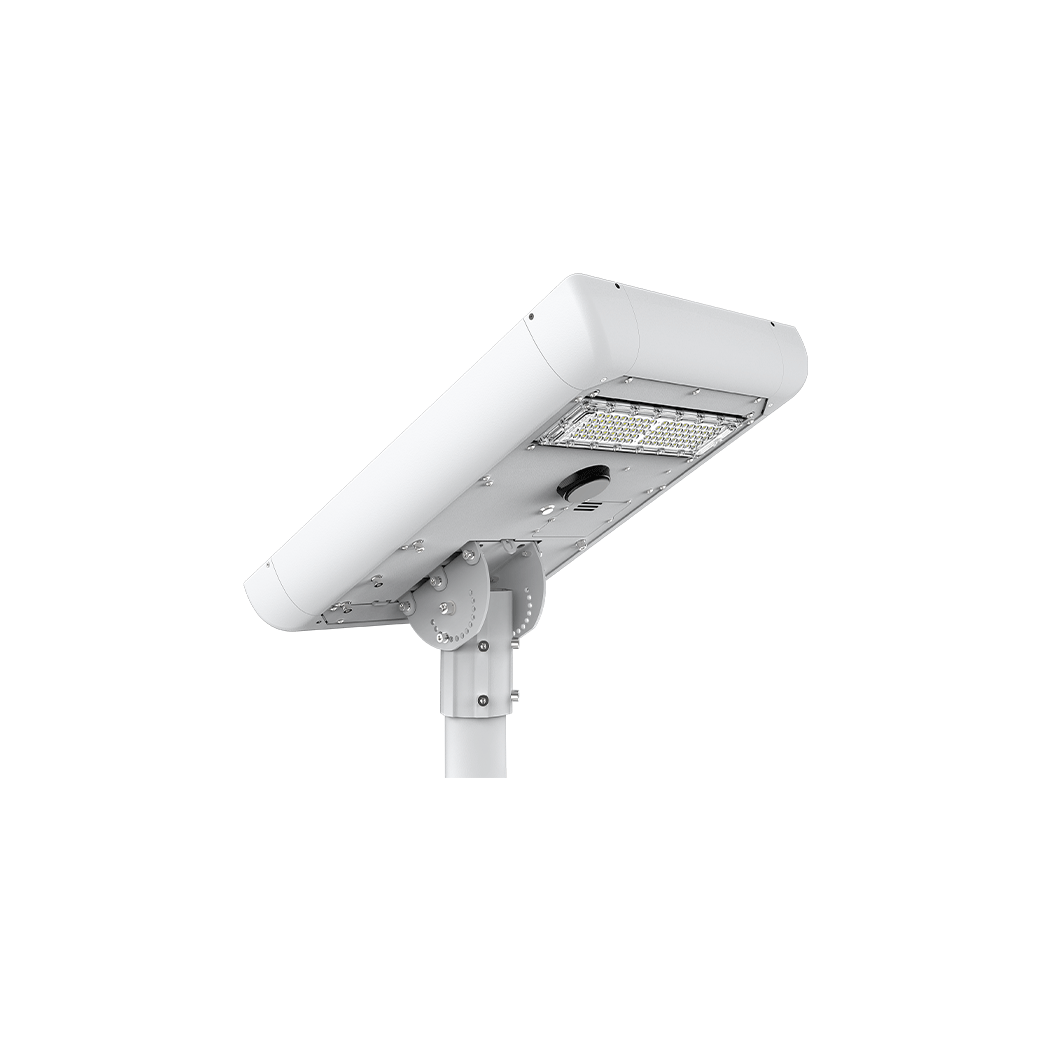
Hulk E III — current solar street-light reference
| Parameter | Project configuration or catalogue reference |
|---|---|
| Historical installed configuration | Around 200 CPSL03 Haoxing solar street lights; three villages |
| Historical controls described | Motion sensing, light sensing and time control |
| Current catalogue light output | 5,000 / 8,500 / 12,000 / 18,000 lm (±10%) |
| Current optical options | 140° × 75° / 120° × 80° |
| Current battery chemistry | Lithium iron phosphate |
| Current enclosure and CCT options | IP65; 3000 / 4000 / 5700 K |
| Selection boundary | Current catalogue reference; not confirmed as the historical installed model. |
5. Plan solar lighting for your village roads
Send a road plan or CAD drawing, road widths, proposed pole positions and mounting heights, and photographs showing buildings, trees and shading. Include the location, required lighting hours, expected night-time activity and any available grid backup. State the required lighting criteria and poor-weather reserve.
Request a free DIALux simulation to review the proposed road layout using matching photometric data. Check solar generation and battery sizing separately against the agreed schedule. Confirm installation details, control settings, site measurements and maintenance responsibilities before commissioning.