Contents
1.Different Methods Need Different Comparisons
A buyer receives two sports lighting proposals. One lists GR 45, and the other lists UGR 19. These assumed values illustrate a common procurement problem. The smaller number cannot identify the more comfortable installation because the results come from different glare models. Neither value is a percentage, and there is no general conversion that makes the two scores interchangeable.

A useful GR vs UGR comparison starts with the intended application, calculation method and viewing conditions. The CPS introduction to sports lighting glare metrics provides background. For a purchasing decision, request the applicable requirement and the underlying model rather than accepting a single catalogue number as proof of compliance.
2.Identify What Each Method Evaluates
CIE 112-1994 describes a glare evaluation system for outdoor sports and area lighting. Its public scope restricts validity to viewing directions below eye level and addresses glare within or close to the illuminated area. It does not assess spill-light effects beyond that area. A satisfactory GR calculation therefore cannot, by itself, resolve every upward ball-tracking view or a neighbouring property complaint.
CIE 117-1995 addresses discomfort glare in interior lighting. Its UGR method recognises observer position and viewing direction. The report also describes a tabular method based on reference conditions. This distinction matters when a supplier quotes a table value rather than a calculation for the proposed hall. Select the required assessment from the project specification and relevant application rules, not from the metric that gives the lowest number.
3.Ask What the Catalogue Number Represents
A luminaire contributes to glare through its visible brightness, distribution and position in the scene. A room or pitch adds geometry and background conditions. A table of reference results is useful for screening, but it cannot establish every installed viewpoint. Ask whether the claim comes from a standard room table, a specific site model or a stated observer calculation. Retain the assumptions with the result.
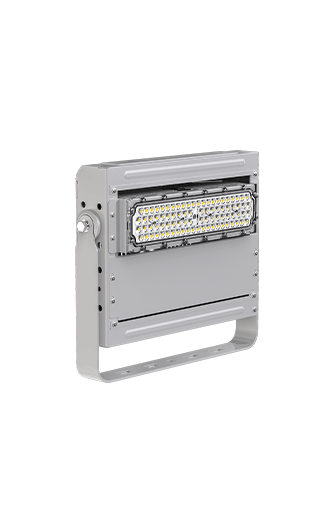
The Dubhe 1000W floodlight has modular optics and mounting options. Its product description is not a GR or UGR approval for every layout. Obtain the exact optic and accessory configuration, with matching photometry. The guide to IES files after changing optics explains why a different lens or shield needs appropriate data rather than a reused distribution with a new label.

4.Compare Proposals Under the Same Conditions
For two comparable proposals, fix the venue geometry, mounting locations, observer coordinates, viewing directions and operating scene. Record the background assumptions and exact photometric files. The CPS calculation-plane guide explains why model height and direction need explicit definitions. A task-plane illuminance grid and an observer-based glare calculation answer different questions; keep both in the report.
Suppose two revisions of the same assumed hall model return UGR 22 and UGR 19 at one unchanged observer. That supports a comparison at that viewpoint under those assumptions. It does not prove the whole hall complies, establish a GR equivalent or show a proportional reduction in discomfort. Check the other required observers and retain minimum illuminance, uniformity and the specified vertical-light results when adjusting the layout.
5.Use Glare Evidence With the Full Design Brief
The CPS Grade III high-pole football project reports four-corner lighting on 18 m lifting poles and average illuminance above 550 lx after commissioning. Those figures describe an installed arrangement. They do not establish a published GR score or an indoor UGR equivalent. Treat case information as context, and ask separately for the glare evidence required by the next venue.
Before approval, check the method, limit, observer schedule, worst-case result and equipment revision in the lighting calculation report. Review critical player sightlines and any separate boundary-light requirements. If a design change reduces glare at the cost of coverage, revise the optics, aiming or positions and recalculate. The useful outcome is a documented layout that meets the venue’s full brief, not a comparison between unrelated numbers.
6.Technical Sources
Keywords: GR vs UGR, Glare Rating, Unified Glare Rating, sports lighting glare, observer positions, glare calculation.