Contents
1.Equal Wattage Does Not Prove Interchangeability
A maintenance team needs to replace a failed sports floodlight. A supplier offers another unit marked 1000 W, and its bracket appears similar. This illustrative situation looks straightforward, but a 1000W floodlight replacement changes more than the power label. The replacement needs to satisfy the existing optical, electrical, mechanical and operating requirements before anyone can call it interchangeable.

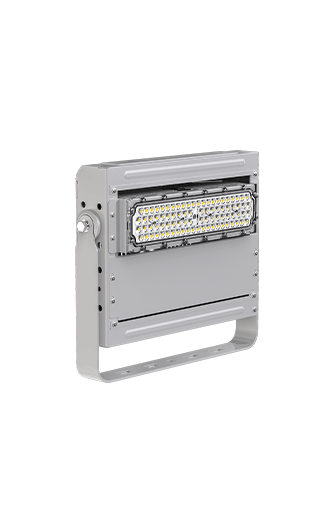
Input watts describe electrical demand at a stated operating condition. They do not identify useful light on the pitch, the beam shape or the mounting interface. The Dubhe 1000W floodlight offers modular optics and mounting options, which makes the exact ordered configuration important. Procurement should compare identifiable assemblies and supporting documents rather than treating a shared wattage as an approval.
2.Compare Distribution Before Comparing Total Lumens
Two assumed 1000 W luminaires rated at 130 lm/W and 150 lm/W produce 130,000 lm and 150,000 lm. The second figure is about 15.4% higher. These are teaching values, not a measured comparison between CPS products. Total flux does not show how much light reaches the task, where the minimum occurs or whether a player sees excessive glare.
A narrower optic can increase intensity in selected directions while leaving surrounding areas weak. A different visor can reduce unwanted light and also change useful coverage. Obtain the matching IES or LDT file for the proposed optic and accessory combination. The CPS guide to photometry after an optics change explains why multiplying an old distribution cannot represent a different beam. Recalculate uniformity, vertical light and relevant boundary limits.

3.Check Supply, Driver Behaviour and Controls
Electrical compatibility starts with the actual supply voltage, frequency, circuit arrangement and protective devices. For an assumed single-phase load, I = P ÷ (V × PF). A 1000 W luminaire at 230 V with power factor 0.90 draws about 4.83 A during that operating condition. This simple estimate excludes startup behaviour and does not size a circuit or breaker.
A replacement driver can have a different inrush peak and duration even when its normal watts match. Ask for those data, leakage-current information, terminal ratings and any restrictions on the number of drivers per switching device. Confirm the exact dimming interface, minimum stable output, control addressing and power-restoration behaviour. A compatible control connector does not establish that the operating scenes will behave identically.
4.Verify Mounting and Environmental Conditions
A bracket that fits the same bolt is only one part of the mechanical check. Compare hole patterns, fasteners, adjustment range, tightening requirements and the clearance needed to maintain aiming. Mass and centre of gravity affect the load at the connection. Housing geometry and effective projected area affect wind actions. The CPS guide to high-mast structural calculations shows why the pole and foundation need review as a system.
Environmental suitability also needs configuration-specific evidence. Confirm the installation temperature range, ingress protection, corrosion exposure and maintenance access. An IP rating does not by itself establish corrosion resistance. Give the supplier the existing pole drawing, circuit details and operating requirements before selecting a substitute. The sports lighting quotation checklist helps assemble the inputs needed to make a replacement proposal reviewable.
5.Approve the Replacement Against the Original Brief
ANSI/IES LM-79-24 provides measurement procedures for electrical power, luminous flux, intensity distribution and colour quantities under standard conditions. Its public scope supports requesting suitable photometric and electrical evidence; it does not certify that two products are interchangeable. Link every file and report to the proposed model, optic, driver setting and accessories. Resolve conflicting catalogue figures with the supplier before approval.
The CPS Grade III high-pole football project reports four-corner placement with 18 m lifting poles and average illuminance above 550 lx after commissioning. That outcome belongs to the installed arrangement; it is not a substitution test. For a replacement, revise the lighting calculation report with the actual proposed equipment and retain comparable grids and operating scenes. Then check installed aiming, controls and specified measurements before signing off the change.
6.Technical Sources
Keywords: 1000W floodlight replacement, LED floodlight interchangeability, photometric data, IES file, driver inrush current, mounting loads, sports lighting retrofit.