Contents
1.Start With the Direction of the Missing Light
A football pitch can look bright from the stand while a player’s face disappears into shadow as the player turns. In this illustrative situation, adding output from the same direction may increase pitch lux without improving the shaded side. Cross-lighting supplies useful light from separated positions so another direction can reach surfaces that one player or object blocks.

The aim is controlled directional coverage, not simply more overlapping beams. The CPS article on sports lighting beam overlap explains why extra overlap can also produce hot spots. Start by identifying the affected player positions, viewing directions and operating scene. Then decide which lighting group can fill the missing direction without placing a bright source in a critical sightline.
2.Understand How Cross-Lighting Fills a Shadow
Light contributions add at a specified surface. If one direction is blocked, an unblocked direction can still illuminate that surface. The table uses deliberately simplified direct-light examples at one horizontal point. It excludes reflected light and partial blockage. These are teaching calculations, not a simulation of a player, CPS product measurements or a target lux level.
Both unblocked examples total 600 lx, but they respond differently when the dominant direction is removed. This shows why equal average illuminance does not establish equal shadow control. Real bodies block light differently as they move. Designers need a spatial layout and suitable visibility checks, rather than assuming that a two-direction arrangement always retains half its light.
3.Control the New Sightlines Before Adding Output
Every added direction can introduce another visible bright source. CIE 112 describes outdoor glare as depending on distribution, aiming, arrangement, mounting height and the brightness of the illuminated area. Cross-lighting can therefore improve a shaded surface while worsening glare from another observer position. A successful revision needs both checks; a softer-looking shadow is not evidence of lower glare.
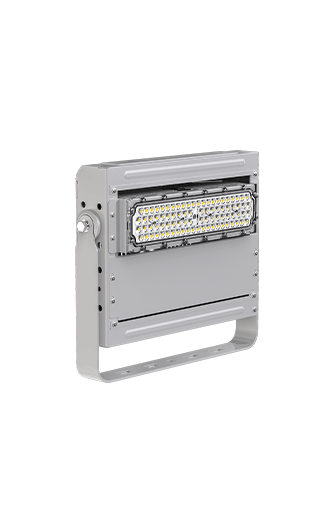
Review source positions from player and goalkeeper viewpoints before increasing driver output. Use suitable optics, shielding and aiming to deliver the required fill. The Dubhe 1000W floodlight has multiple optical and mounting options, so calculations must identify the exact proposed assembly. The CPS guide to floodlight aiming errors shows why a small aiming change can shift useful coverage and create an unwanted bright area.

4.Calculate Vertical Light as Well as Pitch Lux
A horizontal grid measures illumination on the pitch plane. It cannot describe every face orientation or camera direction. Define the required vertical illuminance planes and their orientations, then compare the same geometry and operating scenes before and after the change. The CPS calculation-plane guide explains why height and direction belong in the model specification.
UEFA’s 2023 player-shadow guidance recommends contributions from multiple locations and warns that four-corner tower arrangements cannot consistently produce soft shadows everywhere. Its face-modelling guidance also explains how steep incident light can deepen eye and nose shadows. Those observations support checking the actual geometry. They do not prescribe one universal cross-lighting angle or a fixed balance between opposing groups.
5.Keep the Shadow and Glare Evidence Together
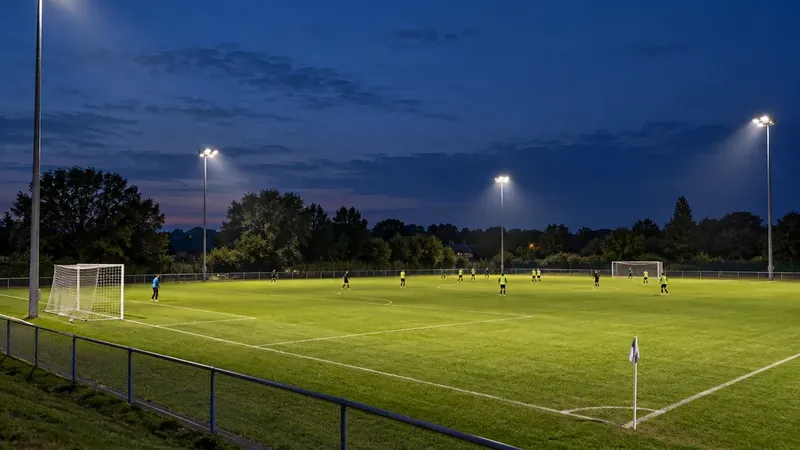
The CPS Grade III high-pole football project reports a four-corner arrangement with 18 m lifting poles and average illuminance above 550 lx after commissioning. This is a real installation example, not a controlled cross-lighting comparison. The published figures do not establish a shadow-reduction percentage or prove that every viewpoint has the same visual comfort.
For a proposed revision, preserve matching photometry, mounting coordinates, aiming groups, dimming settings and observer definitions in the lighting calculation report. Check horizontal and directional vertical results, uniformity, glare and relevant boundaries. UEFA’s glare procedure uses 96 observer positions at 1.75 m with viewing directions assessed every 15°. Its below-eye-level scope also means upward ball-tracking sightlines need separate review. After installation, confirm the actual aiming and inspect visibility in the intended operating scenes.
6.Technical Sources
Keywords: cross-lighting, sports lighting shadow control, vertical illuminance, floodlight aiming, glare control, football lighting layout.