Contents
1.Start With the Player’s Viewing Task
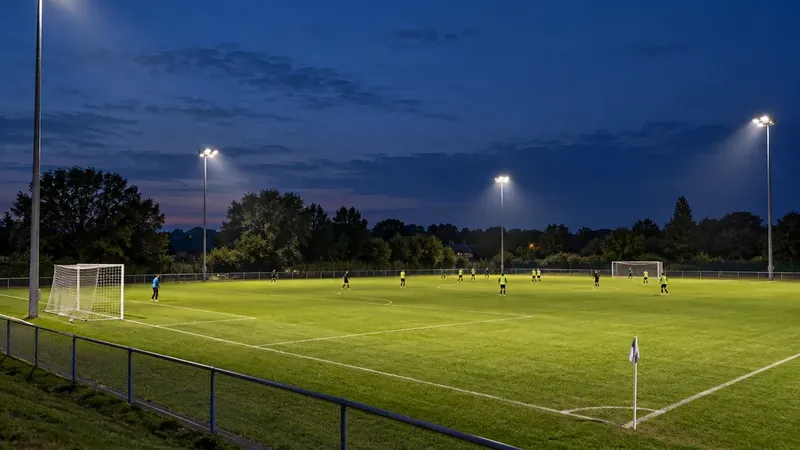
A goalkeeper follows a high cross and briefly looks toward a bright floodlight array. The pitch may still meet its average lux target, yet the source can interrupt ball tracking. This illustrative situation shows why player sightlines belong in the layout brief. A plan that checks only light arriving on the ground leaves an important viewing task unresolved.

List the positions and actions that matter: goalkeeping, receiving long passes and looking toward each touchline. Record the likely viewing directions and operating modes. Keep these tasks alongside the observer calculations described in the CPS GR and UGR comparison. A glare score and a practical review of upward vision provide different evidence.
2.Separate Source Position From Beam Aiming
The observer sees a source at a direction set by its position and height. Turning a luminaire changes the intensity sent toward that observer, but it does not move the luminaire out of that direction. Floodlight placement, optical distribution and aiming must therefore be considered together. A shield can reduce some visible light, but it cannot repair every unsuitable mounting position.
For a simple level-ground example, assume an eye height of 1.75 m and a source height of 20 m. The elevation to the source is arctan[(20 − 1.75) ÷ horizontal distance]. The table shows two results. These are geometric examples, not recommended mounting heights, allowable glare angles or evidence that moving a pole farther away always improves the design.
3.Use Mounting Guidance With Its Reference Geometry
UEFA’s 2023 pitch-perimeter guidance places luminaires 25°–45° above the pitch centre. This angle describes location relative to that reference point. It is not the beam angle, housing tilt or elevation seen by every player. The same guidance prefers at least 20–25 m mounting height where possible and calls for attention to discomfort glare when lower positions are necessary.
The UEFA design diagrams also identify a sensitive zone within 15° on either side of the goal line. They advise against grouped tower luminaires in that zone. Apply the relevant diagram and array type, rather than turning that number into a universal exclusion cone around each player. Different sports and venue classes need their own applicable guidance.
4.Test the View and Preserve Useful Illumination
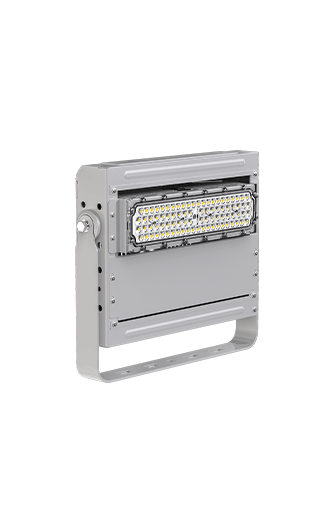
Build the actual mounting coordinates, obstructions, luminaire orientation and operating scenes into the model. Use configuration-specific photometry. The Dubhe 1000W floodlight offers optical and mounting choices, but the product name alone cannot establish acceptable sightlines. The CPS aiming-error guide explains why small rotations can also move useful coverage and create hot spots.
For formal outdoor glare assessment, CIE 112 applies to viewing directions below eye level. A passing result does not cover a player looking directly upward into a luminaire. Review those critical views separately, then recheck horizontal and directional vertical illumination after changing positions or optics. The calculation-plane guide explains why plane direction and height must remain explicit.

5.Connect the Approved Views to Installation
The CPS Grade III high-pole football project reports four-corner lighting on 18 m lifting poles and average illuminance above 550 lx after commissioning. It provides an installed example, not proof that 18 m poles suit every goalkeeper view. The published summary does not provide a controlled player-sightline study or a universal glare result.
At handover, retain fixture IDs, optic codes, mounting coordinates, target points and angle conventions in the lighting calculation report. Confirm installed aiming against the approved revision. Inspect the relevant player positions in the intended modes and record any troublesome source direction. Revise optics, shielding, aiming or locations as needed, then repeat the affected lighting checks. Useful light and visual comfort must survive the same design change.
6.Technical Sources
Keywords: floodlight placement, player sightlines, sports lighting glare, floodlight aiming, mounting geometry.