Contents
1.Ask What Changed Behind the Glare Result
Two lighting proposals show similar pitch illuminance but different glare results. Before choosing the lower score, the buyer needs to know whether both models use the same observers, viewing directions and background assumptions. This is an illustrative review problem, not a product test. A changed input can explain a changed result even when the floodlights and their aiming remain identical.

A useful glare modelling report makes those inputs visible. Begin with the assessment method and applicable project criteria. The CPS GR and UGR comparison explains why different methods cannot be ranked by their numbers alone. For comparable GR studies, keep a shared observer schedule and state any deliberate departures before interpreting the results.
2.Give Every Observer a Position and Direction
An observer definition needs an ID, coordinates, eye height and a viewing direction. A pitch illuminance grid alone does not provide that information. Move the observer or turn the view, and the apparent positions of the bright sources change. The calculation therefore needs more than a single point beside the pitch or an attractive rendering from the stand.
For UEFA’s 2023 football procedure, observers occupy the 96 reference grid positions at 1.75 m above the pitch. Directions are assessed every 15° over a complete turn, and the maximum result and its direction are recorded at each position. That means 24 distinct headings and 2,304 position–heading combinations before additional scenes. These counts describe that procedure, not a universal schedule for every sport.
3.Document the Background the Method Actually Uses
Background luminance is expressed in cd/m²; surface reflectance is a dimensionless input. They are related but are not interchangeable entries. A convincing dark-sky rendering does not establish the background used by a glare calculation. Read the selected method’s documentation, identify how its environment term is obtained, and retain the input basis with the calculation output.
AGi32’s published GR instructions request a grid reflectance and describe observer-specific calculation grids. They also state that this calculation does not account for surrounding or internal reflective and obstructive entities. Adding a stand or a screen to the rendered scene therefore cannot automatically prove that it changes this GR result. Confirm the behaviour of the actual software version and calculation type.
4.Change One Assumption Before Comparing Revisions
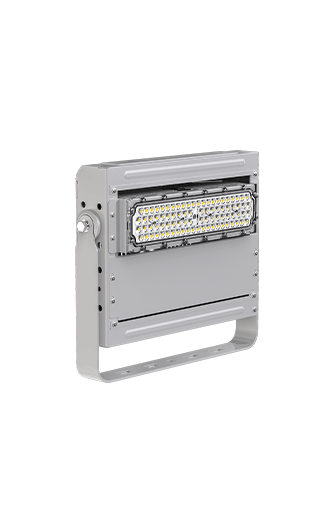
Keep luminaire positions, output settings, photometry and operating scenes fixed while investigating observer or background sensitivity. Then compare the same labelled result set. The Dubhe 1000W floodlight has optical and mounting choices, so the model must identify the proposed configuration. The CPS aiming-error guide explains why an unrecorded rotation can introduce another variable.

Suppose a reviewer tests two explicitly assumed reflectances while keeping the equipment unchanged. The outcome is a sensitivity study, not evidence that the installation improved. Use a justified design basis for acceptance and disclose the alternative assumption. Keep the surface grid and observer definitions separate, as explained in the calculation-plane guide. Do not select a favourable background simply to obtain a pass.
5.Keep Calculation Scope With the Handover Evidence
The CPS Grade III high-pole football project reports four-corner lighting on 18 m poles and average illuminance above 550 lx. Those figures describe an installation, but its public summary does not supply the observer schedule and background inputs needed to reproduce a GR calculation. Request the project-specific calculation evidence separately rather than treating a case photograph as a glare report.
CIE 112 limits its validity to below-eye-level viewing directions and addresses glare within or close to the lit area. Review upward ball tracking and boundary spill light separately. In the lighting calculation report, retain observer coordinates, directions, scene, background basis, equipment revision and worst-case result. During commissioning, confirm the installed arrangement and investigate reported problem views without changing the approved assumptions silently.
6.Technical Sources
Keywords: glare modelling, observer positions, background luminance, grid reflectance, Glare Rating, sports lighting simulation.