Contents
1.Define What the Retrofit Has to Deliver
A club asks whether a 600 W LED floodlight can replace each 1,000 W metal halide lamp. Start by agreeing on the lighting service the club needs. Record the competition level, coverage, uniformity, glare limits and any camera requirements. An older installation may already have dark zones or failed lamps, so preserving its present average could carry those problems into the new design.

Survey the field and inspect the existing equipment. Record fixture count, lamp and ballast types, mounting height, arm positions and tilt. Specify the receiving planes for the new design and the baseline survey. The CPS guide to calculation planes shows how height and orientation change lux readings. The retrofit comparison is meaningful when both options use the same project brief.
2.Compare System Watts and Directional Intensity
The wattage stamped on a metal halide lamp describes the lamp. Its ballast adds losses, so use the complete fixture input for the energy comparison. Use LED fixture input including its driver on the other side. The DOE CALiPER floodlight study tested one 100 W metal halide lamp in a fixture that drew 131.2 W and emitted 5,238 lumens. That result applies to the tested configuration.

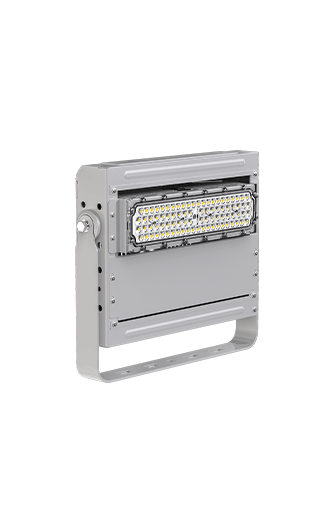
Fixture lumens describe total output. The CPS Dubhe floodlight, for example, is offered with different distributions. Light at any point on the field depends on the candela in that direction, the throw distance and the angle to the receiving plane. An optic that reaches the far touchline may leave too little light close to the mast. Request the exact photometry for the proposed output, lens and any visor.
3.Compare Two Layouts at Maintained Output
Model both layouts with the same pitch grid, required viewing directions and assessment criteria. Use a documented maintenance factor appropriate to each system and the cleaning plan. UEFA’s stadium guide accounts for ageing and dirt losses. The CPS photometric simulation guide explains how fixture settings and aiming enter the model.
In this hypothetical comparison, the brief calls for at least 500 lx maintained average and a minimum-to-average ratio of 0.60. The illuminance figures below are assumed outcomes for illustration. The connected loads and ratios are calculated. Option A reaches the average but leaves the minimum too low. Option B passes those two checks, although it still needs glare, spill and any required vertical illuminance verification.
4.Calculate Savings After the Lighting Checks
The existing connected load in the example is 26.4 kW. Option B draws 15.0 kW, a reduction of about 43%. At an assumed 1,500 full-output hours a year, annual energy falls from 39,600 to 22,500 kWh, a difference of 17,100 kWh. Use metered input or documented circuit power where possible. For dimmed scenes, multiply each scene’s input by its hours and sum the results.
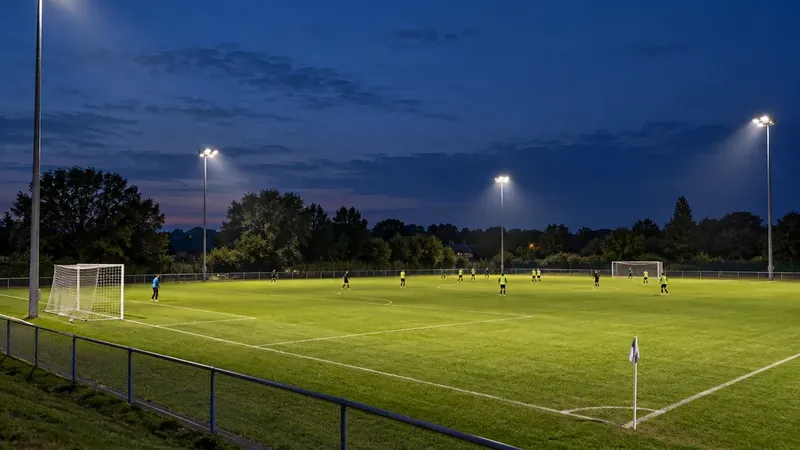
In the CPS Grade II football retrofit case, the team describes a four-corner high-mast layout and project-specific optical simulation and commissioning. Those steps are the part to carry forward into another project. A different pitch geometry, mounting point or required lighting class can change the fixture count and the savings estimate.
5.Specify Evidence Before Ordering Fixtures
Ask for an option-by-option lighting calculation report that names each optic, input wattage, aiming angle and maintenance basis. Include maintained minimum and average values, the uniformity definition, and the relevant glare and spill results. Check that the mounting and electrical arrangements suit the installed equipment before releasing the order.
At commissioning, verify the installed equipment against the schedule. The CPS aiming guide shows why a small change in angle can shift a bright patch or leave a gap. Measure representative lighting modes on the agreed grid, and record circuit power under equivalent conditions. That gives the owner a baseline for both the lighting performance and the energy result.
6.Technical Sources
Keywords: metal halide to LED retrofit, LED retrofit wattage, system input power, sports lighting photometry, maintained illuminance, lighting uniformity.