Contents
1.Define the Production Before Choosing a Lux Target
A club streams a match from one fixed camera. Next season, it plans close-ups, reverse angles and slow-motion replays. The same pitch now needs a different lighting review, even if the audience still watches online. This illustrative upgrade shows why broadcast lighting requirements start with the production brief. The delivery platform alone does not define the lighting class.

A basic stream may have fewer camera positions and no high-speed replay. A major online production may use the same demanding capture methods as television. Record the sport, competition rules, camera locations, frame rates, exposure settings and replay needs before specifying illuminance. UEFA links broadcast conditions to competition-specific requirements; it does not provide one universal target for every internet stream.
2.Light the Players From the Required Camera Directions
Horizontal illuminance, or Eh, describes light received on the playing surface. Vertical illuminance, or Ev, helps assess light reaching upright subjects from a stated direction. A bright pitch can still leave faces dark toward one camera. The CPS calculation-plane guide explains why receiving height and direction must stay attached to each reported lux value.
One main camera and several reverse-angle cameras need different sets of checks. Model every required direction and review minimum values, uniformity, shadows and glare. Adding output from the wrong direction can strengthen shadows without solving the camera view. A DIALux or AGi32 simulation should use the actual mounting positions, selected optics and planned operating scenes.
3.Explain Why Shorter Exposures Need More Light
A camera gathers light during each exposure. With scene brightness, aperture and camera settings otherwise unchanged, a shorter exposure collects less light. The following calculated examples assume exposure time equals half the frame interval. Operators can choose other settings, so these numbers are an exposure comparison, not a prescribed camera setup or a lighting standard.
Changing from 1/50 s to 1/400 s cuts exposure duration by a factor of eight. Restoring the same sensor exposure through scene illumination alone would require eight times the light under those fixed assumptions. In practice, the camera team also considers aperture and gain. Higher gain can raise noise, and a wider aperture can reduce depth of field. Agree on those compromises before sizing the lighting system.
4.Test Flicker in the Actual Recording Modes
More lux does not remove temporal light modulation. LED driver behaviour, dimming and the camera’s sampling can produce brightness changes or bands. UEFA’s 2023 guidance says a flicker factor below 3% generally avoids problems up to 300 fps, while noting technology differences. This guidance is not a guarantee for every shutter setting or a replacement for the applicable competition criteria.
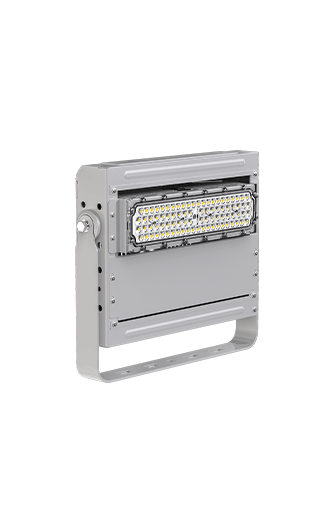
Test the specified frame rates, shutter settings and dimming scenes with the proposed equipment. Include spectator areas: background lighting can flicker even when the pitch looks clean. The Dubhe 1000W floodlight offers multiple optical choices, but a product description cannot establish whole-venue camera performance. Request configuration-specific driver and modulation evidence, then confirm the installed result.

5.Turn the Camera Brief Into an Acceptance Plan
The CPS Grade III high-pole football project reports four-corner lighting on 18 m poles and average illuminance above 550 lx. Those published figures describe that installation. They do not establish camera-facing Ev, replay performance or television approval. A similar venue should use its own camera brief and measurements when planning a broadcast upgrade.
Keep the approved camera plan, plane definitions, equipment configuration, colour requirements and flicker test settings in the lighting calculation report. Check aiming against the installed schedule; the floodlight aiming guide explains common setup errors. During commissioning, measure the agreed grids and record representative footage. Streaming and television both need an evidence-based brief; the production determines how demanding that brief becomes.
6.Technical Sources
Keywords: broadcast lighting requirements, sports livestream lighting, vertical illuminance, camera exposure, slow-motion flicker, stadium lighting design.